
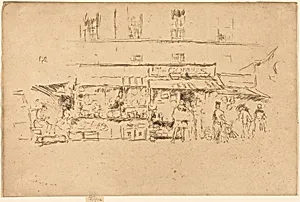
Quai de Montebello
Medium
etching and drypoint on laid paper
Dimensions
plate (cut to plate mark): 15.1 × 22.7 cm (5 15/16 × 8 15/16 in.)
Classification
Department
CG-W
Museum
National Gallery of Art, Washington, D.C.
Credit
Rosenwald Collection
Accession Number
1943.3.8650
Rights
Public Domain
Art Historical Context
James McNeill Whistler, renowned American-born artist celebrated for his subtle tonal harmonies and Aesthetic movement affiliations, captured the essence of Parisian life in *Quai de Monteb* (1893). This intimate etching depicts the bustling Quai de Montebello the Seine River, a vibrant hub in late 19th-century Paris. Whistler's work reflects his fascination with urban nocturnes and atmospheric effects, honed during his time in France and England, where he championed "art for art's sake" over narrative detail. Printed in etching and drypoint on laid—a textured, handmade sheet that enhances the print's delicate grain—the piece measures just 15.1 × 22.7 cm, inviting close contemplation. Etching allowed Whistler to incise precise lines into a copper plate with acid, while drypoint's hand-scratched burrs created velvety, soft edges and rich tonal depth, evoking mist and shadow along the riverbank. These techniques, perfected in his Thames and Venice series, elevated printmaking to fine art status. Housed in the National Gallery of Art's Rosenwald Collection, *Quai de Montebello* exemplifies Whistler's mastery in distilling everyday scenes into poetic impressions, influencing modern graphic arts and bridging Impressionism with Symbolism. Visitors will appreciate its quiet elegance, a window into Belle Époque Paris.
About the Artist
James McNeill Whistler · 1834–1903
James Abbott McNeill Whistler (1834-1903) was an American-born painter and printmaker who became a leading figure in the Aesthetic Movement and pioneer of Tonalism and Japonisme. He revolutionized art by championing "art for art's sake" and treating paintings as visual equivalents of musical compositions, titling works as "arrangements," "harmonies," and "nocturnes" to emphasize formal qualities o...