
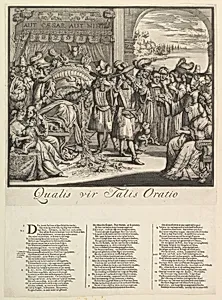
Qualis vir Talis Oratio
n.d.
Medium
Etching and letterpress
Dimensions
sheet: 21 1/4 x 15 1/2 in. (54 x 39.4 cm)
Classification
Prints
Department
Drawings and Prints
Museum
Metropolitan Museum of Art, New York, NY
Credit
The Elisha Whittelsey Collection, The Elisha Whittelsey Fund, 1949
Accession Number
49.95.691
Rights
Public Domain
Tags
Art Historical Context
Romeyn de Hooghe, a prolific Dutch artist of the late 17th century, was renowned for his sharp-witted satirical prints that lampooned politics, society, and authority figures during the Baroque era. *Qualis vir Talis Or* (Latin for "Like the man, so his speech," echoing Horace's idea that a person's words reflect their character) exemplifies his biting style. Created as an etching combined with letterpress—techniques that allowed for intricate lines, expressive details, and integrated text—this undated work measures an imposing 21¼ x 15½ inches, making it a bold statement piece in the printmaking tradition. The print's tags reveal a humorous yet pointed satire featuring kings, dogs, men, and women, likely mocking pretentious rulers or courtiers whose grandiose speeches betray their flaws. De Hooghe often used animals like dogs to caricature human folly, drawing parallels between canine antics and royal bombast amid the turbulent politics of the Dutch Golden Age and wars with France. Etching's fine burin work enabled vivid contrasts and dynamic compositions, while letterpress added textual punchlines, enhancing its role as political commentary. Housed in The Metropolitan Museum of Art's Elisha Whittelsey Collection, this print highlights de Hooghe's mastery in using accessible media to critique power, offering visitors a window into 17th-century Europe's satirical edge. It's a reminder that art has long been a mirror—and a funhouse one at that—to society's leaders.
About the Artist
Romeyn de Hooghe · 1645–1708
Romeyn de Hooghe (1645-1708) was a Dutch Baroque engraver, draughtsman, and political satirist who became the most prolific and versatile graphic artist of the Dutch Republic in the late seventeenth century. Born in Amsterdam, he rose to become one of early modern Europe's most important printmakers and a pioneering master of political satire. De Hooghe's significance extends far beyond his techn...