
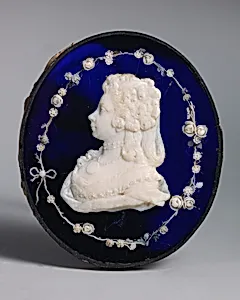
Queen Charlotte
Unknown Artist
ca. 1765
Medium
Ivory mounted on blue glass oval
Dimensions
Overall: 7.3 × 6.4 cm
Classification
Sculpture-Miniature
Culture
British
Department
European Sculpture and Decorative Arts
Museum
Metropolitan Museum of Art, New York, NY
Credit
Gift of Elna Linborg Friedman, 1986
Accession Number
1986.94.2
Rights
Public Domain
Tags
Art Historical Context
This exquisite miniature sculpture, titled *Queen Charlotte*, captures the elegance of Britain's Georgian era around 1765. Crafted by an unknown artist, it depicts the profile of Queen Charlotte, consort to King George III, who ascended the throne in 1761. Adorned with floral garlands—a motif symbolizing royal grace and fertility—the piece is carved from ivory and mounted on a striking blue glass oval, measuring just 7.3 × 6.4 cm. Such intimate portraits were prized as personal treasures, often worn as jewelry or kept in private collections. Ivory miniatures like this exemplify the virtuoso carving techniques of 18th-century British artisans, where delicate relief work brought royal likenesses to life in miniature scale. The blue glass backing enhances the ivory's translucency, creating a luminous effect that draws the eye to fine details like the queen's coiffure and jewelry. Housed in the Metropolitan Museum of Art's European Sculpture and Decorative Arts department (gift of Elna Linborg Friedman, 1986), it reflects the era's fascination with portraiture as a mark of status and devotion. Queen Charlotte's image here evokes her role as a cultural patron and mother of 15 children, embodying Enlightenment ideals of refinement. These tiny masterpieces offer a window into courtly life, blending artistry with personal sentiment in a portable form of royal commemoration.