
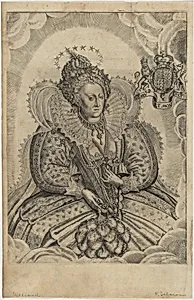
Queen Elizabeth
published 1630
Medium
engraving
Dimensions
plate: 21.9 × 15.5 cm (8 5/8 × 6 1/8 in.)
Classification
Department
CG-E
Museum
National Gallery of Art, Washington, D.C.
Credit
Rosenwald Collection
Accession Number
1951.11.115
Rights
Public Domain
Art Historical Context
This engraving of Queen Elizabeth, created by Francis Delaram and published in 1630, captures the enduring legacy of Elizabeth I long after her death in 1603. Delaram, an accomplished printmaker working in early Stuart England, produced this posthumous portrait to honor the queen’s iconic status. The work reflects how her image remained a powerful symbol of national identity and Protestant strength well into the 17th century. As an engraving, the medium allowed for detailed line work and tonal shading that could be reproduced in multiple impressions. This made royal portraits accessible beyond court circles, helping shape public memory of the monarch through affordable, widely circulated prints. At roughly 22 by 15.5 centimeters, the plate size suited personal collections or albums, underscoring printmaking’s role in broadening art’s reach. Now part of the National Gallery of Art’s Rosenwald Collection, the engraving preserves Elizabethan iconography while demonstrating the artistic and cultural importance of early modern print techniques.
About the Artist
Francis Delaram · 1590–1627
Francis Delaram (c. 1590–1627) was a prolific English engraver active in London during the early Jacobean era, producing several hundred plates that captured the likenesses of monarchs, nobles, and scholars. Flourishing from around 1615, he specialized in line engravings for portraits, title pages, and book illustrations, often working after prominent painters. His output contributed significantly...