
Queen Jane Seymour
March 26, 1795
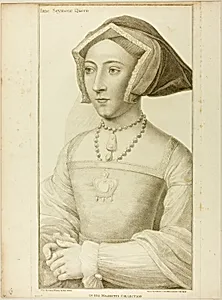
Medium
Stipple engraving on cream wove paper
Dimensions
Image: 52.1 × 28.3 cm (20 9/16 × 11 3/16 in.); Plate: 54 × 31 cm (21 5/16 × 12 1/4 in.); Sheet: 54 × 40.1 cm (21 5/16 × 15 13/16 in.)
Classification
engraving
Department
Prints and Drawings
Museum
Art Institute of Chicago
Accession Number
126192
Rights
Public Domain
Art Historical Context
This exquisite stipple engraving, *Queen Jane Seymour*, crafted by Francesco Bartolozzi March 26, 1795, captures the poised elegance of Henry VIII's third wife, mother of Edward VI.olozzi, a masterful engraver who flourished in England during the late 18th century, renowned for his reproductive prints that brought Renaissance portraits to a wider audience. Likely based on Hans Holbein the Younger's iconic original, this work revives the Tudor queen's serene beauty for Regency-era viewers, her elaborate gown and jewelry evoking the opulence of the 1530s English court. The medium—stipple engraving on cream wove paper—highlights Bartolozzi's innovative technique of building tones through fine dots rather than lines, creating a soft, painterly effect ideal for subtle flesh tones and textures. Measuring an impressive image size of 52.1 × 28.3 cm, the print's large scale allowed for intricate detail, making it a prized collector's item. Housed in the Art Institute of Chicago's Prints and Drawings department, it exemplifies the era's booming print culture, democratizing art history. Jane Seymour's tragic story—dying just days after childbirth in 1537—adds poignant depth, symbolizing fleeting youth amid royal intrigue. This engraving not only preserves her legacy but also showcases how 18th-century artists bridged historical reverence with technical virtuosity.
About the Artist
Francesco Bartolozzi · 1727–1815
Francesco Bartolozzi (1727–1815) was an Italian engraver whose most productive period was spent in London, where he became the leading exponent of stipple engraving and a founding member of the Royal Academy. Born in Florence and trained first as a painter before turning to engraving in Venice, he established his reputation in Rome before being recruited by the English Royal Librarian Richard Dalt...