
Quillwork Sconce
Unknown Artist
1720–49
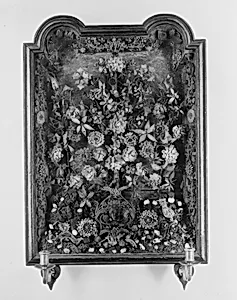
Medium
Paper, glass, shells, wire, brass
Dimensions
32 x 20 3/4 in. (81.3 x 52.7 cm)
Classification
Sconce
Department
The American Wing
Museum
Metropolitan Museum of Art, New York, NY
Credit
Gift of Mrs. J. Woodhull Overton, in memory of her mother, Mrs. J. Insley Blair, 1953
Accession Number
53.197.2
Rights
Public Domain
Tags
Art Historical Context
Nestled in The American Wing of the Metropolitan Museum of Art, this *Quillwork Sconce* (1720–49) is a captivating example of early colonial American decorative arts. Crafted by an unknown artist, this wall-mounted lighting fixture measures 32 x 20 3/4 inches and features an intricate combination of paper, glass, shells, wire, and brass. The title hints at quillwork—a delicate technique often involving dyed porcupine quills meticulously appliquéd to form vibrant patterns—adorned here with floral motifs that evoke the natural beauty of the New World. Dating to the first half of the 18th century, the sconce reflects the ingenuity of colonial craftsmen blending European design influences with indigenous materials and methods. Quillwork, prized for its luminosity and fine detail, was a specialized craft associated with Native American traditions, particularly among Eastern Woodland peoples, and occasionally adapted in settler households for luxurious home illumination. Once lit by candles, it would have cast a warm, flickering glow through its glass elements, highlighting the shimmering shells and metallic accents. Generously gifted in 1953 by Mrs. J. Woodhull Overton in memory of her mother, Mrs. J. Insley Blair, this rare sconce offers visitors a glimpse into the opulent domestic life of early America, where functionality met exquisite artistry.