
Quilt (Section)
c. 1936
Medium
watercolor and graphite on paper
Dimensions
overall: 35.6 x 26.6 cm (14 x 10 1/2 in.)
Classification
Index of American Design
Department
CG-W
Museum
National Gallery of Art, Washington, D.C.
Credit
Index of American Design
Accession Number
1943.8.308
Rights
Public Domain
Art Historical Context
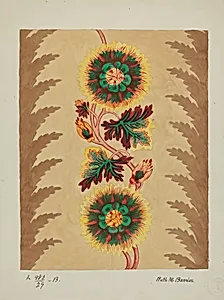
This delicate watercolor and graphite rendering, titled *Quilt (Section)*, was created by Ruth M. Barnes around 1936 as part of the Index of American Design—a monumental Federal Art Project under the Works Progress Administration (WPA). Launched during the Great Depression, the Index aimed to celebrate and preserve America's rich folk art heritage by commissioning artists to document everyday objects, crafts, and designs through precise, full-color illustrations. Barnes' work captures a detailed section of a traditional American quilt, highlighting the intricate patterns and craftsmanship that defined regional textile traditions. Rendered on paper measuring 14 x 10½ inches, the piece masterfully employs watercolor for vibrant hues and graphite for fine lines, mimicking the quilt's textures and stitches with remarkable fidelity. This technique not only served as an archival record but also elevated utilitarian folk art to the level of fine art, bridging craft and aesthetics in the spirit of the American Design movement. Today, housed in the National Gallery of Art's Index of American Design collection, this artwork reminds us of the ingenuity of anonymous makers whose quilts warmed homes and told stories across generations. It stands as a testament to cultural resilience during economic hardship, inviting visitors to appreciate the beauty in America's everyday artistry.
About the Artist
Ruth M. Barnes · 1880–1954
Ruth M. Barnes (1880–1954) was an American artist best known for her meticulous watercolor renderings of traditional American folk textiles as part of the Index of American Design, a Federal Art Project under the Works Progress Administration (WPA). Active during the Great Depression era from roughly 1935 to 1942, Barnes contributed dozens of detailed studies to this ambitious initiative, which em...