
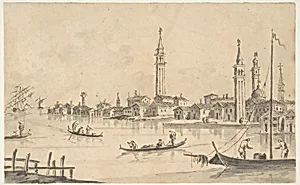
Quinta Valle at Castello
1764–1835
Medium
Pen and brown ink, brush and gray wash, over traces of black chalk
Dimensions
4 13/16 x 7 13/16in. (12.3 x 19.9cm)
Classification
Drawings
Department
Drawings and Prints
Museum
Metropolitan Museum of Art, New York, NY
Credit
Bequest of Alexandrine Sinsheimer, 1958
Accession Number
59.23.47
Rights
Public Domain
Tags
Art Historical Context
Giacomo Guardi's *Quinta Valle at Castello* (. 1764–1835) offers a captivating glimpse into Venice's Castello district, a sestiere known for grand buildings, soaring towers, and bustling waterways dotted with boats. As the son of the renowned vedutista Francesco Guardi, Giacomo continued the family tradition of meticulously rendering the city's architectural splendor and atmospheric charm. This small-scale drawing, measuring just 4 13/16 x 7 13/16 inches, evokes the everyday vibrancy of 18th-century Venetian life, blending urban structures with the lagoon's reflective calm. Executed in pen and brown ink with brush and gray wash over traces of black chalk, the work showcases Guardi's skillful command of mixed media. These techniques—common in Venetian draftsmanship—allowed for precise linework to define forms, while subtle washes built depth, light, and shadow, mimicking the city's ever-shifting play of sun on water and stone. Such drawings often served as studies for larger paintings, highlighting the Guardis' role in preserving Venice's fading grandeur amid political shifts like Napoleon's conquest. Today, this gem resides in the Metropolitan Museum of Art's Drawings and Prints department, a bequest from Alexandrine Sinsheimer in 1958. It stands as a testament to the enduring allure of Venetian vedute, inviting viewers to wander the canals through Guardi's expert eye.
About the Artist
Giacomo Guardi · 1764–1835
Giacomo Guardi (1764–1835) was a Venetian painter who worked in the long shadow of his celebrated father, Francesco Guardi, one of the greatest vedutisti — view painters — of the eighteenth century. Born into one of Venice's most prominent artistic families, Giacomo received his training directly from his father, absorbing both the technical methods and the characteristic style that had made Franc...