
Raadhuis te Brussel
1847
Medium
striking (metalworking)
Dimensions
5; 522
Rights
Public Domain
About this artwork
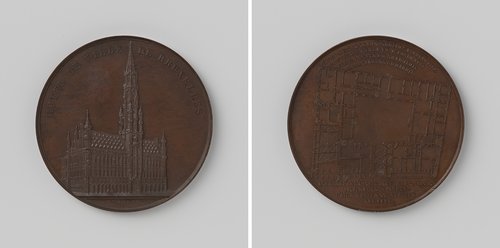
Bronzen penning. Voorzijde: raadhuis binnen omschrift; afsnede: signatuur. Keerzijde: plattegrond van raadhuis binnen vierregelig omschrift; afsnede: opschrift
Art Historical Context
**Raadhuis te BrusselBrussels Town Hall), 7** Created by Belgian medallist Jacob Wiener in 1847, this bronzepenning*—a struck medal measuring 5 cm in diameter and weighing a substantial 522 grams—celebrates one of Brussels' most iconic landmarks, the Gothic Town Hall on the Grand Place. Wiener, a master of 19th-century numismatic art, captures the architectural splendor of this 15th-century masterpiece, known for its intricate facade, towering belfry, and symbolic role in Belgian civic life. Struck during a period of growing national pride in Belgium's newly independent heritage, the medal reflects the era's fascination with historical monuments as emblems of cultural identity. The obverse features a detailed view of the Town Hall encircled by an inscription, with Wiener's signature on the edge, showcasing his precision in metalworking. The reverse presents a precise floor plan of the building within a four-line inscription, also edged with text—likely dedicatory or descriptive. This dual-sided design, typical of commemorative medals, blends realism with topography, highlighting the Town Hall's structural elegance and inviting viewers to appreciate its layout. As a fine example of struck bronze technique, where high-pressure dies imprint intricate details into metal, Wiener's work exemplifies the technical virtuosity of mid-19th-century European medal craft. Perfect for collectors and history enthusiasts, it offers a tangible connection to Brussels' enduring architectural legacy. (198 words)
About the Artist
Jacob Wiener · 1815–1899
Jacob Wiener (1815–1899), also known as Jacques Wiener, was a Belgian medallist and engraver of exceptional skill whose work left an indelible mark on 19th-century European numismatic art. Born on February 27, 1815, in Hoerstgen (in present-day Germany), Wiener would become one of Belgium's most distinguished engravers, contributing significantly to the young nation's cultural identity through his...