
Rabbi Reading
1919-1920
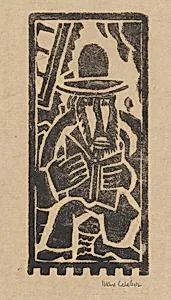
Medium
woodcut in black on laid paper
Dimensions
image: 10.8 × 4.92 cm (4 1/4 × 1 15/16 in.) sheet: 22.23 × 15.24 cm (8 3/4 × 6 in.)
Classification
Department
CG-W
Museum
National Gallery of Art, Washington, D.C.
Credit
Gift of Jack and Margrit Vanderryn
Accession Number
2015.114.7
Rights
Public Domain
Art Historical Context
**Rabbi Reading** is a poignant woodcut created by Max Weber between 1919 and 1920, capturing a rabbi deeply engrossed in study. This intimate print, measuring just 10.8 × 4.92 cm, exemplifies Weber's modernist sensibility. Born in Russia and later a key figure in early American modernism, Weber drew from his Jewish heritage to spiritual contemplation amid the cultural upheavals following World War I. The work reflects a moment when Jewish artists in America were blending tradition with innovative forms, evoking quiet reverence through stark contrasts. Printed in black ink on laid paper—a textured, handmade sheet common in fine art prints—the woodcut technique highlights Weber's mastery of relief printing. By carving away the wood block's surface, he achieved bold, simplified lines and dramatic shadows that emphasize the rabbi's focused expression and flowing beard. This medium, with its tactile directness, lent prints accessibility, allowing broader dissemination of modernist ideas during the interwar era. Housed in the National Gallery of Art as a gift from Jack and Margrit Vanderryn, **Rabbi Reading** invites visitors to ponder the enduring power of scholarship and faith. Its small scale draws the eye close, mirroring the personal devotion it depicts—a timeless gem in Weber's oeuvre bridging old-world piety and 20th-century abstraction.
About the Artist
Max Weber · 1881–1961
Max Weber (1881–1961), born in Białystok in the Russian Empire (now Poland) to Orthodox Jewish parents, immigrated to Brooklyn, New York, at age ten with his family, joining his tailor father.) There, he pursued art studies at the Pratt Institute under Arthur Wesley Dow, an innovative teacher who emphasized expression and form over traditional narrative, drawing from Japanese art and Paul Gauguin....