
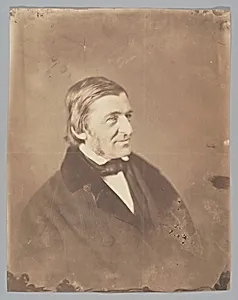
Ralph Waldo Emerson
ca. 1856
Medium
Salted paper print from glass negative
Dimensions
Image: 13 1/4 × 10 13/16 in. (33.7 × 27.5 cm)
Classification
Photographs
Department
Photographs
Museum
Metropolitan Museum of Art, New York, NY
Credit
Gilman Collection, Purchase, Mr. and Mrs. Henry R. Kravis Gift, 2005
Accession Number
2005.100.1228
Rights
Public Domain
Tags
Art Historical Context
Step into the world of mid-19th-century America with Mathew B. Brady's striking portrait of Ralph Waldo Emerson created around 1856. Brady, a pioneering photographer whose studio captured the era's luminaries—from presidents to poets—immortalized Emerson, the leading voice of American Transcendentalism. This salted paper print from a glass negative, measuring 13 1/4 × 10 13/16 inches, exemplifies Brady's mastery in elevating photography from novelty to portraiture art form. Emerson, with his thoughtful gaze and neatly trimmed beard, embodies the intellectual ferment of antebellum America. A philosopher, essayist, and abolitionist, he championed self-reliance and nature's divinity in works like "Nature" (1836) and "Self-Reliance" (1841). Brady's image, likely taken in his New York studio, freezes Emerson at the peak of his influence, just before the Civil War reshaped the nation. The medium's significance lies in its technical innovation: the glass negative, produced via the wet collodion process, allowed for detailed, richly toned prints on salted paper—a hallmark of 1850s photography. This technique captured subtle textures and soft lighting, lending Emerson a contemplative depth that mirrored his introspective writings. Housed in The Metropolitan Museum of Art's Gilman Collection, this photograph bridges art and history, inviting us to ponder the man behind the ideas.
About the Artist
Mathew B. Brady · 1823–1896
Mathew B. Brady (c. 1823–1896) was an American photographer who became the most famous photographer of the Civil War era and one of the founding figures of American photographic history. Born in Warren County, New York, to Irish immigrant parents, he learned the daguerreotype process from Samuel F.B. Morse and William Page and opened his first portrait studio in New York City in 1844. Brady quick...