
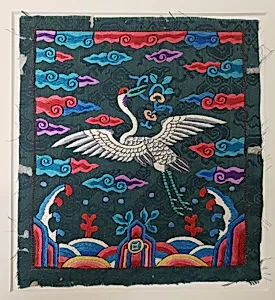
Rank Badge with Crane
Unknown Artist
late 19th century
Medium
Silk
Dimensions
9 1/4 x 8 1/4 in. (23.50 x 20.95 cm)
Classification
Textiles-Embroidered
Culture & Period
Korea · Joseon dynasty (1392–1910)
Department
Asian Art
Museum
Metropolitan Museum of Art, New York, NY
Credit
Seymour Fund, 1953
Accession Number
53.60.2
Rights
Public Domain
Tags
Art Historical Context
This delicate **Rank Badge with Crane**, in the late 19th century during Korea's Joseon dynasty (2–1910), is a finely embroidered silk textile measuring 9¼ x 8¼ inches. Produced by an unknown artist, it exemplifies exquisite craftsmanship of Joseon-era textiles, where silk's lustrous sheen provided an ideal canvas for intricate needlework. Such badges, known as *hyebyeon*, were sewn onto the chests of officials' robes, serving as visible markers of rank and status in the rigidly hierarchical Confucian society. The central motif of the crane holds profound cultural significance in Korean tradition, symbolizing longevity, wisdom, and high moral virtue—qualities befitting elite civil bureaucrats. Cranes often denoted the upper echelons of the yangban class, fluttering gracefully amid stylized clouds or waves rendered in vibrant silk threads of gold, blue, and red. This piece reflects the Joseon emphasis on symbolism and technical precision, with embroidery techniques like couching and satin stitch creating texture and depth. Acquired through the Seymour Fund in 1953, this badge now graces the Metropolitan Museum of Art's Asian Art collection, offering a glimpse into the daily splendor of Joseon's scholarly elite. A testament to enduring artistry, it invites us to appreciate how fabric conveyed power and poetry in pre-modern Korea.