
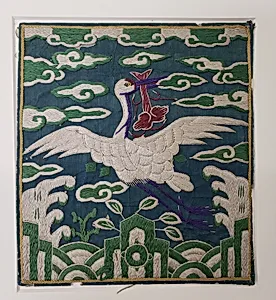
Rank Badge with White Crane
Unknown Artist
late 19th century
Medium
Silk
Dimensions
7 1/2 x 7 in. (19.05 x 17.78 cm)
Classification
Textiles-Embroidered
Culture & Period
Korea · Joseon dynasty (1392–1910)
Department
Asian Art
Museum
Metropolitan Museum of Art, New York, NY
Credit
Seymour Fund, 1953
Accession Number
53.60.7
Rights
Public Domain
Tags
Art Historical Context
This exquisite **Rank Badge with White Crane**, crafted in silk during the late 19th century of Korea's Joseon dynasty (1392–1910), as a vital emblem of official status. Worn as a square patch on the chest and back of civil servants' robes, these badges—known as *hyangwon*—denoted rank through symbolic motifs. The white crane, meticulously embroidered here, signified the highest first-rank officials, embodying Confucian ideals of longevity, purity, and scholarly virtue in a rigidly hierarchical society. The badge's small size (7½ x 7 in.) belies its intricate artistry. Fine silk provided a luxurious, shimmering ground for elaborate embroidery techniques, likely using satin and chain stitches to capture the crane's graceful form amid swirling clouds and stylized waves. Such textiles highlight Joseon craftsmanship, where sumptuary laws strictly regulated motifs to prevent social blurring, reinforcing the dynasty's Neo-Confucian order. Today, at the Metropolitan Museum of Art (acquired via the Seymour Fund in 1953), this piece offers a window into Joseon's bureaucratic elegance, blending functionality with profound symbolism. Cranes, revered in Korean culture as harbingers of good fortune, remind us of art's role in everyday power dynamics.