
Rank Badge with Paradise Fly-Catcher
Unknown Artist
late 18th century
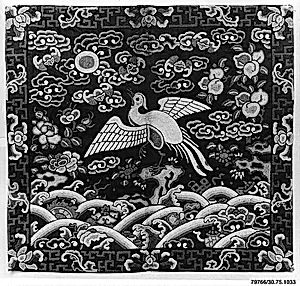
Medium
Silk
Dimensions
11 3/4 x 12 3/4 in. (29.84 x 32.38 cm)
Classification
Textiles-Embroidered
Culture & Period
China · Qing dynasty (1644–1911)
Department
Asian Art
Museum
Metropolitan Museum of Art, New York, NY
Credit
Bequest of William Christian Paul, 1929
Accession Number
30.75.1033
Rights
Public Domain
Tags
Art Historical Context
This exquisite silk rank badge embroidered during China's Qing dynasty (1644–1911) in the late 18th, served as a mandarin square affixed to the robes of high-ranking officials. Worn prominently on the chest and back, these badges denoted social status and civil or military hierarchy: birds like the Paradise Fly-C symbolized civilian ranks, distinguishing wearers in the imperial bureaucracy. Measuring a compact 11¾ x 12¾ inches, it reflects the precision and prestige of Qing court attire. Crafted in vibrant silk threads, the embroidery showcases masterful techniques such as couching, satin stitch, and metal-wrapped threads for a luxurious sheen. The central Paradise Fly-Catcher, perched amid foliage, is joined by auspicious bats—symbols of good fortune (fu) in Chinese culture—and other birds, blending naturalism with symbolic depth. These motifs evoked harmony between heaven and earth, underscoring Confucian ideals of order. Now housed in the Metropolitan Museum of Art's Asian Art Department (Bequest of William Christian Paul, 1929), this badge offers a window into Qing opulence and the intricate artistry of anonymous court embroiderers, whose skill elevated everyday symbols into emblems of power.