
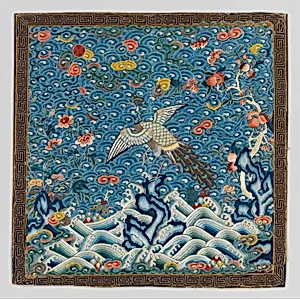
Rank Badge with Peacock
Unknown Artist
late 18th–early 19th century
Medium
Silk, metallic thread on silk
Dimensions
12 1/2 x 12 1/2 in. (31.75 x 31.75 cm)
Classification
Textiles-Embroidered
Culture & Period
China · Qing dynasty (1644–1911)
Department
Asian Art
Museum
Metropolitan Museum of Art, New York, NY
Credit
Bequest of William Christian Paul, 1929
Accession Number
30.75.913
Rights
Public Domain
Tags
Art Historical Context
This exquisite **Rank Badge with Peacock**, crafted in late 18th– 19th-century China during the Qing dynasty (4–1911), is a finely embroidered square of silk adorned with metallic threads. Worn on officials' robes, these mandarin squares publicly displayed rank and status in imperial bureaucracy—peacocks denoted high-ranking civil servants, symbolizing beauty, dignity, and protection, while bats fluttering nearby represented good fortune (fu in Chinese, evoking blessings and longevity). The embroidery technique showcases masterful Qing textile artistry: intricate stitching with shimmering gold and silver threads creates lifelike feathers and dynamic poses, elevating silk from everyday fabric to a status symbol. At 12½ x 12½ inches, its compact size belied its wearer's authority, blending functionality with opulent symbolism in a hierarchical society. Bequeathed to the Metropolitan Museum of Art in 1929, this anonymous masterpiece offers a window into China's refined court culture, where every motif carried profound meaning. Visitors, imagine the badge glinting under palace lanterns as its owner navigated the emperor's world!