
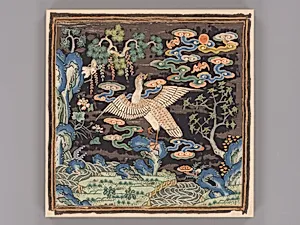
Rank Badge with Wild Goose
Unknown Artist
18th century
Medium
Silk and metallic thread embroidery on silk satin
Dimensions
Overall: 9 1/2 x 9 1/2 in. (24.1 x 24.1 cm)
Classification
Textiles-Embroidered
Culture & Period
China · Qing dynasty (1644–1911)
Department
Asian Art
Museum
Metropolitan Museum of Art, New York, NY
Credit
Bequest of William Christian Paul, 1929
Accession Number
30.75.874
Rights
Public Domain
Tags
Art Historical Context
This exquisite rank badge, embroidered with a majestic wild goose, hails from 18th-century China during Qing dynasty (16441911). Square in shape at 9½ x 9½ inches, it was designed to be sewn onto the chest or back of an official's robe, serving as a visible marker of status in the rigid imperial bureaucracy. The wild goose motif specifically denoted a fourth-rank civil official symbolizing ambition and seasonal migration—qualities admired in Confucian scholars who rose through rigorous examinations. Crafted from silk satin with silk and metallic threads, the badge showcases the pinnacle of Qing embroidery techniques. Artisans employed intricate stitching methods like satin stitch and couching to create shimmering feathers and a sense of lifelike motion against a watery background, often evoking rivers or clouds. These badges were produced in imperial workshops, blending functionality with artistry to affirm the wearer's loyalty and hierarchy. Today, this piece from the Metropolitan Museum of Art's Asian Art collection, bequeathed by William Christian Paul in 1929, offers a window into everyday symbols of power in imperial China. Marvel at its delicate luster—a testament to craftsmanship that elevated even clothing to imperial splendor.