
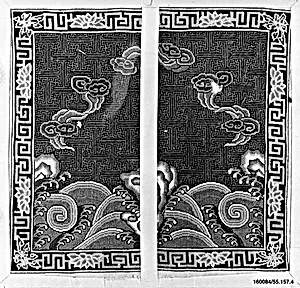
Rank Badge with Waves and Rocks
Unknown Artist
late 19th–early 20th century
Medium
Silk, metallic thread
Dimensions
9 x 9 1/2 in. (22.86 x 24.13 cm)
Classification
Textiles-Embroidered
Culture & Period
China · Qing dynasty (1644–1911)
Department
Asian Art
Museum
Metropolitan Museum of Art, New York, NY
Credit
Gift of Alice Boney, 1955
Accession Number
55.157.4
Rights
Public Domain
Tags
Art Historical Context
Welcome to the Asian Art galleries at the Metropolitan Museum of Art where we encounter the exquisite *Rank Badge with Waves and*, an embroidered silk square from late 19th–early 20th-century China during the Qing dynasty (1644–1911). Measuring a modest 9 x 9½ inches, this unknown artist's creation was a vital symbol of imperial hierarchy. Worn as a square patch (known as a *biao*) on the chest and back of officials' robes, it denoted rank within the vast Qing bureaucracy, adhering to strict sumptuary laws that regulated dress by status. The badge's dynamic design of swirling waves and rugged rocks, rendered in vibrant silk threads and shimmering metallic accents, evokes the power of nature—perhaps alluding to rivers or the sea, motifs often linked to civil officials of mid-level ranks. Embroiderers employed sophisticated techniques like satin stitch for smooth surfaces, couching for metallic outlines, and intricate shading to create depth and movement, showcasing the era's mastery of textiles as wearable art. These badges were not just functional but status symbols, reflecting Confucian ideals of order and the emperor's authority. A generous gift of Alice Boney in 1955, this piece invites us to imagine a mandarins' procession, where every stitch whispered rank and prestige. (198 words)