
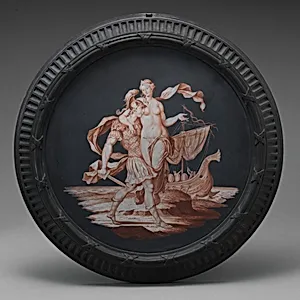
Rape of Helen
1780–90
Medium
Black basalt ware with "encaustic" decoration
Dimensions
Diam. 13 5/8 in. (34.6 cm)
Classification
Ceramics-Pottery
Culture
British, Etruria, Staffordshire
Department
European Sculpture and Decorative Arts
Museum
Metropolitan Museum of Art, New York, NY
Credit
Rogers Fund, 1931
Accession Number
31.84.1
Rights
Public Domain
Tags
Art Historical Context
In the late 18th century, potter Josiah Wedgwood ceramics with his innovative black basalt ware, a fine-grained, unglazed stoneware fired to a rich matte black that mimicked the somber elegance of ancient Greek and pottery. Produced at his Etruria factory in between 1780 and 1790, *Rape of Helen* this neoclassical revival. The circular plaque, measuring 13⅝ inches in diameter, the mythic abduction of Helen of Troy by Paris, complete with figures of men and ships—a pivotal moment from classical lore that ignited the Trojan War. Wedgwood's choice of subject reflects the era's fascination with antiquity, fueled by archaeological discoveries like those at Pompeii. The artwork's "encaustic" decoration refers to Wedgwood's pioneering technique of inlaying colored clays into the black body before firing, creating durable, vibrant contrasts without paints that might fade. This method elevated ceramics from mere utility to high art, bridging decorative arts and sculpture. Housed in the Metropolitan Museum of Art's European Sculpture and Decorative Arts department since 1931, *Rape of Helen* showcases Wedgwood's technical genius and cultural ambition, making ancient myths accessible to Georgian elites and collectors. A testament to British industrial artistry, it invites us to ponder timeless tales of love, war, and beauty etched in enduring clay.
About the Artist
Josiah Wedgwood · 1730–1795
Josiah Wedgwood (1730–1795) was born in Burslem, Staffordshire, the thirteenth child of a potter whose family had worked in the craft since the seventeenth century. Apprenticed to his elder brother Thomas following their father's death, he went on to a partnership with Thomas Whieldon of Fenton — the most respected potter in England at the time — which gave him command of all the principal techniq...