
Rape of the Sabines
1499–1543
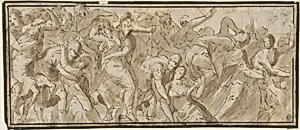
Medium
Pen and brown ink, brush and brown wash
Dimensions
6-1/2 x 15-1/4 in. (16.6 x 38.8 cm)
Classification
Drawings
Department
Drawings and Prints
Museum
Metropolitan Museum of Art, New York, NY
Credit
Gift of Cornelius Vanderbilt, 1880
Accession Number
80.3.40
Rights
Public Domain
Tags
Art Historical Context
In the dynamic drawing *Rape of the Sab*, Polidoro da Caravaggio (c. 1499–1543) captures a pivotal moment from Roman mythology. The scene depicts the ancient legend where Romulus and his Roman warriors abduct women from the neighboring Sabine tribe to secure wives and grow their city—Rome's mythic founding tale of desperation and conquest. Created during the High Renaissance, this work reflects Polidoro's Mannerist style, marked by twisting figures, dramatic tension, and emotional intensity, influenced by his training under Raphael and his work decorating Rome's Palazzo Milesi with illusionistic frescoes. Executed in pen and brown ink with brush and brown wash on a narrow horizontal sheet (6-1/2 x 15-1/4 in.), the medium allows for fluid line work and subtle tonal modeling, evoking deep shadows and movement ideal for a frieze-like composition. This technique, common in preparatory sketches of the era, highlights Polidoro's skill in conveying chaos and suffering—evident in the entangled men and women—while foreshadowing Baroque dynamism. A generous gift from Cornelius Vanderbilt in 1880, this Metropolitan Museum of Art treasure offers a window into 16th-century draftsmanship and the era's fascination with classical antiquity, reminding us how art immortalizes humanity's rawest struggles.
About the Artist
Polidoro da Caravaggio · 1492–present
Polidoro Caldara, known as Polidoro da Caravaggio, was born around 1499 in Caravaggio, Lombardy, and emerged as one of the most innovative painters of the early Mannerist period. Arriving in Rome circa 1515 as an untrained laborer hauling plaster for the Vatican Logge decorations, he quickly caught the eye of Raphael's key assistant, Maturino da Firenze. By 1517, Polidoro had joined Raphael's work...