
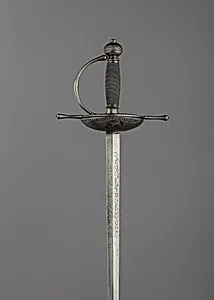
Rapier with Scabbard
Unknown Artist
early 18th century
Medium
Steel, leather, brass
Dimensions
L. with scabbard 39 1/8 in. (99.4 cm); L. without scabbard 38 1/4 in. (97.1 cm); L. of blade 32 1/4 in. (81.9 cm); W. 7 in. (17.8 cm); D. 3 3/4 in. (9.5 cm); Wt. 1 lb. 4 oz. (567 g); Wt. of scabbard 3 oz. (85 g)
Classification
Swords
Culture
Italian
Department
Arms and Armor
Museum
Metropolitan Museum of Art, New York, NY
Credit
Gift of William H. Riggs, 1913
Accession Number
14.25.1030a, b
Rights
Public Domain
Art Historical Context
This elegant rapier with scabbard, crafted in early 18th-century Italy, showcases the masterful blend of function and artistry in European arms making. Forged primarily from steel for the blademeasuring an impressive 32¼ inches—the weapon features a leather-wrapped grip for secure handling and brass fittings that add both durability and subtle ornamentation. At just over a pound (with the scabbard weighing a mere 3 ounces), lightweight design (total length 39⅛ inches) reflects the era's emphasis on agility and precision in combat. By the early 1700s, rapiers like this one had become symbols of status among Italian nobility and military officers, transitioning from battlefield use to civilian dueling and self-defense. Italian swordsmiths, renowned for their technical prowess, produced such pieces in workshops across regions like Milan and Naples, where steel was tempered to a keen edge and components meticulously fitted for balance. A generous gift to the Metropolitan Museum of Art from William H. Riggs in 1913, this rapier now resides in the Arms and Armor department. It invites visitors to appreciate how weapons doubled as wearable art, embodying the cultural valor and craftsmanship of Baroque-era Italy.