
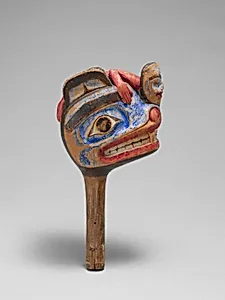
Rattle
Unknown Artist
19th century
Medium
Wood, pebbles, polychrome
Dimensions
Overall: 7.6 x 20.3cm (3 x 8in.)
Classification
Idiophone-Shaken-rattle
Culture
Native American (Skittagetan or Haida)
Department
Musical Instruments
Museum
Metropolitan Museum of Art, New York, NY
Credit
The Crosby Brown Collection of Musical Instruments, 1889
Accession Number
89.4.616
Rights
Public Domain
Tags
Art Historical Context
This exquisite 19th-century rattle crafted by an unknown Native American artist from the Skittaget or Haida culture of the Northwest Coast, exemplifies the blend of artistry and functionality in indigenous musical traditions. Measuring just 7.6 x 20.3 cm (3 x 8 in.), it is a compact idiophone—a shaken rattlefashioned from wood filled with pebbles that create a rhythmic clatter when vibrated. Its surface bears polychrome decoration, with vibrant paints applied to highlight carved elements, including motifs tagged as "heads," likely representing ancestral spirits, animals, or supernatural figures central to Haida cosmology. In Skittagetan or Haida society, such rattles held profound cultural importance, serving as essential tools in shamanistic rituals, potlatch ceremonies, and storytelling dances. Shaken to invoke rhythms that mimicked natural sounds or summoned supernatural forces, they bridged the physical and spiritual worlds, embodying the maker's mastery of formline carving—a hallmark of Northwest Coast aesthetics where bold, interlocking lines convey narrative power. Acquired as part of The Crosby Brown Collection of Musical Instruments in 1889 and now housed in the Metropolitan Museum of Art's Department of Musical Instruments, this rattle offers visitors a tangible connection to vibrant indigenous heritage, reminding us of the rattles' role as both sonic and visual storytellers.