
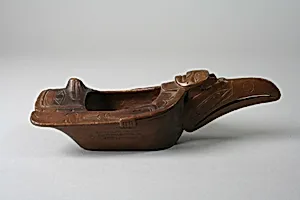
Raven Bowl
Unknown Artist
ca. 1870 (?)
Medium
Wood, paint
Dimensions
H. 3 3/8 x W. 7 3/8 in. (8.6 x 18.7 cm)
Classification
Wood-Containers
Culture
Haida
Department
Arts of Africa, Oceania, and the Americas
Museum
Metropolitan Museum of Art, New York, NY
Credit
The Michael C. Rockefeller Memorial Collection, Purchase, Nelson A. Rockefeller Gift, 1965
Accession Number
1978.412.138
Rights
Public Domain
Tags
Art Historical Context
Behold the **Raven Bowl**, a masterful example of Haida artistry from the Pacific Northwest Coast, dating to around 1870. Crafted from wood and adorned with paint, this compact container measures just 3⅜ × 7⅜ inches, yet it pulses with cultural vitality. The Haida people, renowned for their intricate carvings and deep spiritual connections to the natural world, produced such objects as both functional vessels and profound symbols of identity. At its heart is the raven—a trickster, creator, and ancestral emblem in Haida mythology. The bowl's surface likely features boldly stylized faces and formlines, characteristic of Northwest Coast style, where painted and carved motifs blend realism with abstraction to evoke supernatural power. These techniques, using sharp knives and natural pigments, transformed everyday wood into heirlooms passed down through clans, used in feasts, rituals, or storage. Acquired through The Michael C. Rockefeller Memorial Collection at The Metropolitan Museum of Art, this piece highlights the Haida's enduring legacy amid 19th-century colonial pressures. It invites us to ponder how art bridged the mundane and the mythic, preserving stories in every curve. (198 words)