
Reading
1879/1887
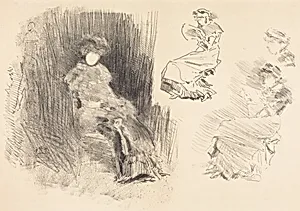
Medium
lithograph in black on wove paper
Dimensions
image: 25.3 × 36.6 cm (9 15/16 × 14 7/16 in.) sheet: 28.5 × 42 cm (11 1/4 × 16 9/16 in.)
Classification
Department
CG-W
Museum
National Gallery of Art, Washington, D.C.
Credit
Rosenwald Collection
Accession Number
1943.3.8674
Rights
Public Domain
Art Historical Context
James McNeill Whistler (1834–1903), the American-born artist who became a leading figure in London's Aesthetic movement, created *Reading* between 1879 and 1887. Renowned for his emphasis on "art for art sake," Whistler prioritized tonal harmony, subtle colors, and evocative atmospheres over narrative detail—principles evident in masterpieces like *Arrangement in Grey and Black No.1* (Whistler's Mother). This print captures a quiet moment of contemplation, aligning with his interest in everyday subjects elevated to poetic elegance during the late Victorian era. Executed as a lithograph in black on wove paper (image: 25.3 × 36.6 cm), *Reading* showcases Whistler's mastery of the medium. Lithography, a planographic process invented in the late 18th century, allowed him to achieve fluid, painterly effects through greasy crayon on stone, then transferred to paper. Whistler championed prints as fine art, producing innovative series that rivaled his oils and pastels. The modest scale and monochromatic palette invite viewers to savor nuanced shading and line work, reflecting his "nocturne" aesthetic even in daylight scenes. Housed in the National Gallery of Art's Rosenwald Collection (Department: CG-W), this work exemplifies Whistler's influence on modern printmaking and the Symbolist movement. Its cultural resonance lies in transforming the mundane act of reading into a timeless meditation on stillness and perception, perfect for quiet gallery reflection.
About the Artist
James McNeill Whistler · 1834–1903
James Abbott McNeill Whistler (1834-1903) was an American-born painter and printmaker who became a leading figure in the Aesthetic Movement and pioneer of Tonalism and Japonisme. He revolutionized art by championing "art for art's sake" and treating paintings as visual equivalents of musical compositions, titling works as "arrangements," "harmonies," and "nocturnes" to emphasize formal qualities o...