
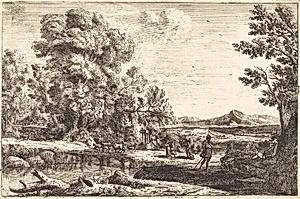
Rebecca and Eliezer (Le pont de bois)
c. 1638/1641
Medium
etching (with drypoint?)
Classification
Department
CG-E
Museum
National Gallery of Art, Washington, D.C.
Credit
Gift of Philip Hofer
Accession Number
1941.3.2
Rights
Public Domain
Art Historical Context
Claude Lorrain’s etching *Rebecca and Eliezer (Le pont de bois)* captures a tender moment from the biblical story in Genesis, where Abraham’s servant Eliezer encounters Rebecca at a well. Created around 1638–1641 during the artist’s early years in Rome, the print places the figures within a sweeping pastoral landscape anchored by a rustic wooden bridge. This integration of narrative and nature reflects the Baroque era’s growing interest in harmonious, idealized scenery that elevates everyday or sacred events. Lorrain, celebrated for his luminous landscapes, used etching—sometimes enhanced with drypoint—to achieve delicate tonal gradations and atmospheric depth. The medium allowed wide circulation of his compositions, bringing his distinctive vision of light and space to collectors across Europe. Here, the bridge serves as both a structural focal point and a symbolic threshold, guiding the viewer’s eye through the scene while underscoring themes of journey and divine providence. Acquired by the National Gallery of Art as a gift from Philip Hofer, this print exemplifies Lorrain’s skill at merging classical subject matter with the natural world, inviting viewers to appreciate both the story and the serene beauty of the setting.
About the Artist
Claude Lorrain · 1604–1682
Claude Lorrain (c. 1600-1682), born Claude Gellée in the village of Chamagne in northeastern France's Duchy of Lorraine, stands as one of the most influential landscape painters in Western art history. Orphaned by age twelve, his journey to artistic mastery was unconventional—beginning with apprenticeships in pastry-making and inlay work before destiny led him to Rome around 1620, where he would s...