
Reciting Poetry in a Garden
Unknown Artist
first quarter 17th century
Medium
Stonepaste; polychrome glaze within black wax resist outlines (cuerda seca technique)
Dimensions
Panel with tabs: H. 35 1/4 in. (89.5 cm) W. 61 3/8 in. (155.9 cm) D. 2 1/2 in. (6.4 cm) Wt. 300 lbs. (136.1 kg) Each tile: H. 8 7/8 in. (22.5 cm) W. 8 7/8 in. (22.5 cm)
Classification
Ceramics-Tiles
Department
Islamic Art
Museum
Metropolitan Museum of Art, New York, NY
Credit
Rogers Fund, 1903
Accession Number
03.9b
Rights
Public Domain
Tags
Art Historical Context
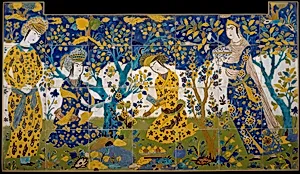
Step into a serene 17th-century garden with *Reciting Poetry in a Garden*, a magnificent tile panel crafted in the first quarter of that century by an unknown artist from the Islamic world. This expansive work, composed of numerous square tiles (each about 9 inches across), assembles into a 35-by-61-inch vista weighing a hefty 300 pounds. vividly captures men and women gathered amid lush trees, blooming flowers, and verdant foliage, engaged in the refined pastime of poetry recitation—a hallmark of elite leisure in Persianate and Ottoman cultures. The panel showcases the cuerda seca technique, a masterful Islamic ceramic method using stonepaste (fritware) body and black wax resist outlines to contain vibrant polychrome glazes during firing. This innovation prevented colors from bleeding, yielding sharp, jewel-like hues perfect for architectural decoration. Such large-scale panels often graced palace pavilions, mosques, or private gardens, evoking the Islamic paradise garden (janna) as described in poetry and scripture. Housed in the Metropolitan Museum of Art's Islamic Art department (Rogers Fund, 1903), this piece highlights the era's fusion of artistry and spirituality, where gardens symbolized eternal bliss and poetry bridged the earthly and divine. Its monumental tabs suggest it was designed for wall installation, immersing viewers in timeless elegance.