
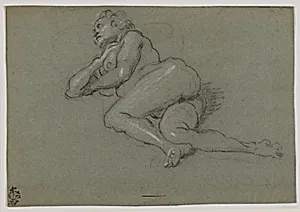
Reclining Female Nude
late 16th century
Medium
Black and white chalk on blue paper
Dimensions
7 13/16 x 11 1/4 in. (19.8 x 28.5 cm)
Classification
Drawings
Department
Robert Lehman Collection
Museum
Metropolitan Museum of Art, New York, NY
Credit
Robert Lehman Collection, 1975
Accession Number
1975.1.535
Rights
Public Domain
Tags
Art Historical Context
This exquisite drawing by Domenico Tintoretto captures the graceful form of a reclining female nude with remarkable sensitivity and economy of line. Created in the late sixteenth century, the work reflects the enduring Renaissance fascination with the human body as both an anatomical study and an ideal of beauty. As the son of the celebrated Venetian master Jacopo Tintoretto, Domenico inherited a dynamic approach to figure drawing that emphasized movement, light, and volume. The choice of black and white chalk on blue paper is particularly significant. Venetian artists favored tinted papers for their ability to create subtle tonal contrasts, allowing the white chalk to suggest highlights while the blue ground provides a middle tone that enhances the illusion of three-dimensional form. This technique was often used for preparatory studies, bridging the gap between initial sketches and finished paintings. Now housed in the Metropolitan Museum of Art’s Robert Lehman Collection, the drawing offers modern viewers an intimate glimpse into the working methods of a prominent Venetian workshop. Its modest scale invites close looking, revealing how even a simple study could embody the period’s deep appreciation for both technical skill and the natural beauty of the human figure.
About the Artist
Domenico Tintoretto · 1560–1635
Son and assistant of the famous Venetian painter, Jacopo Robusti, called Tintoretto. He is known primarily as a portrait painter, although Domenico executed other subjects as well. Comment on works: religious, mythology, Portraits