
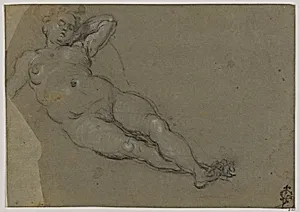
Reclining Female Nude
early 17th century
Medium
Black and white chalk on blue paper
Dimensions
7 1/2 x 10 5/8 in. (19 x 27 cm)
Classification
Drawings
Department
Robert Lehman Collection
Museum
Metropolitan Museum of Art, New York, NY
Credit
Robert Lehman Collection, 1975
Accession Number
1975.1.537
Rights
Public Domain
Tags
Art Historical Context
Domenico Tintoretto’s *Reclining Female Nude* captures the quiet grace of the human form in a delicate study from the early seventeenth century. As the son of the celebrated Venetian master Jacopo Tintoretto, Domenico carried forward his family’s workshop traditions into the Baroque era, often producing preparatory drawings that explored anatomy and movement with remarkable sensitivity. Executed in black and white chalk on blue paper, the drawing exemplifies a technique favored by Venetian artists. The cool blue ground allowed the contrasting chalks to create luminous highlights and soft shadows, lending the figure a sculptural presence despite the work’s modest size. Such studies were essential tools for developing larger compositions destined for churches and palaces. Now part of the Metropolitan Museum’s Robert Lehman Collection, this intimate sheet offers visitors a glimpse into the private practice of one of Venice’s most influential artistic dynasties. Its focus on the reclining nude reflects the period’s enduring fascination with the body as both a vehicle for ideal beauty and a subject of careful observation.
About the Artist
Domenico Tintoretto · 1560–1635
Son and assistant of the famous Venetian painter, Jacopo Robusti, called Tintoretto. He is known primarily as a portrait painter, although Domenico executed other subjects as well. Comment on works: religious, mythology, Portraits