
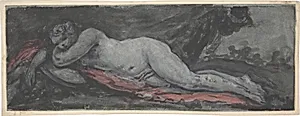
Reclining Nude
late 18th or early 19th century
Medium
Black, white, and red tempera on blue paper
Dimensions
3 1/8 x 8 5/8 in. (7.9 x 21.9 cm)
Classification
Drawings
Department
Drawings and Prints
Museum
Metropolitan Museum of Art, New York, NY
Credit
Gift of Harry G. Friedman, 1959
Accession Number
59.644.41
Rights
Public Domain
Tags
Art Historical Context
This delicate drawing, titled *Reclining Nude*, captures the graceful form of a woman in a relaxed pose, rendered with remarkable subtlety. Created by an anonymous French artist in the late 18th or early 19th century, the work exemplifies the period’s interest in the human figure as both an ideal of beauty and a subject for artistic study. Its modest scale—just over three by eight inches—suggests it may have served as a preparatory sketch or a collector’s intimate treasure. The artist employed black, white, and red tempera on blue paper, a technique that heightens the luminous quality of the figure against the cool ground. This three-color method, popular among French draftsmen, allowed for nuanced modeling of light and shadow while evoking the warmth of living flesh. Such drawings often reflected academic training or the influence of Rococo and Neoclassical currents, bridging sensuality with refined observation. Now part of the Metropolitan Museum’s Department of Drawings and Prints, this piece reminds us of the enduring appeal of the nude in Western art. Its gift to the museum in 1959 by Harry G. Friedman underscores how even small, unsigned works preserve valuable insights into the artistic practices of their time.
About the Artist
Anonymous, French, 18th century · 1700–1800
The artist known as Anonymous, French, 18th century, represents a collective of unidentified talents active roughly between 1700 and 1800, a period of profound artistic evolution in France from the opulent Rococo to the austere dawn of Neoclassicism and Revolutionary fervor. Little is documented about their personal training or mentors, as their anonymity obscures individual biographies, though th...