
Reclining Nude with Cat
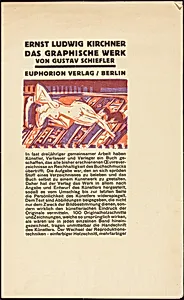
Medium
color woodcut on folded book prospectus
Dimensions
block: 6.2 x 9.4 cm (2 7/16 x 3 11/16 in.) sheet (folded): 26.5 x 16.2 cm (10 7/16 x 6 3/8 in.) sheet (unfolded): 26.5 x 32.4 cm (10 7/16 x 12 3/4 in.)
Classification
Department
CG-W
Museum
National Gallery of Art, Washington, D.C.
Credit
Gift of Ruth Cole Kainen
Accession Number
2007.75.2
Rights
Public Domain
Art Historical Context
**Reclining Nude with** is a striking color woodcut created by Ernst Ludwig Kirchner in 1924, a pivotal figure in German Expressionism and co-founder of the Die Brücke group. This intimate work captures a reclining nude figure accompanied by a cat, rendered with Kirchner's signature bold lines and vibrant hues that convey emotional intensity and raw vitality. Produced during his later years in Switzerland, amid struggles and recovery from wartime trauma, it reflects the artist's fascination with the human form and domestic motifs, blending sensuality with a touch of whimsy. The medium—a color woodcut printed on a folded book prospectus—highlights Kirchner's mastery of the woodcut technique, which he revitalized in the early 20th century. The tiny block (just 6.2 x 9.4 cm) allowed for intricate, hand-carved details, while the unfolded sheet expands to 26.5 x 32.4 cm, suggesting it served as promotional material for an artist's book or publication. This innovative use of everyday paper underscores Kirchner's experimental spirit, bridging fine art with printmaking accessibility. Housed in the National Gallery of Art's Prints department (gift of Ruth Cole Kainen), this piece exemplifies how Kirchner pushed woodcuts beyond black-and-white traditions into vivid color, influencing modern graphic arts. Visitors will appreciate its compact scale, inviting close inspection of its expressive power.
About the Artist
Ernst Ludwig Kirchner · 1880–1938
Ernst Ludwig Kirchner was born on May 6, 1880, in Aschaffenburg, Germany, to parents Ernst and Maria Kirchner, part of a family of Prussian descent that frequently relocated due to his father's career as a chemical technician. After early schooling in various towns, he studied architecture at the Königliche Technische Hochschule (Technical University) in Dresden from 1901 to 1905, taking courses i...