
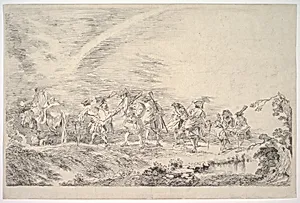
Recruits Going to Join the Regiment
ca. 1715–16
Medium
Etching with drypoint
Dimensions
8 7/8 x 13 7/16 in. (22.6 x 34.2 cm)
Classification
Prints
Department
Drawings and Prints
Museum
Metropolitan Museum of Art, New York, NY
Credit
Purchase, Gift of Dr. Mortimer Sackler, Theresa Sackler and Family, and The Elisha Whittelsey Collection, The Elisha Whittelsey Fund, 2006
Accession Number
2006.43
Rights
Public Domain
Tags
Art Historical Context
Antoine Watteau's *Recruits Going to Join the Regiment* (ca. 1715–16) captures a lively military procession, featuring men, soldiers, and horses trudging toward enlistment. This etching with drypoint, measuring 8 7/8 x 13 7/16 inches, showcases Watteau's mastery in translating his fluid drawing style into print. Best known for his dreamy *fêtes galantes* scenes of aristocratic leisure in the early Rococo era, Watteau here reveals his versatility, drawing from his early experiences sketching troops during the War of the Spanish Succession (1701–1714). The artwork's historical context reflects post-war France under Louis XV, where recruitment drives symbolized national resilience amid social shifts. Watteau's etching technique—lines incised with acid and enriched by drypoint's velvety burr—creates a sense of movement and texture, evoking the dust and energy of the march. This rare print, acquired by the Metropolitan Museum of Art in 2006, highlights Watteau's innovative printmaking, bridging painting and graphics with delicate, atmospheric depth. Visitors will appreciate how this piece contrasts Watteau's typical elegance with raw, everyday heroism, offering a poignant glimpse into 18th-century life.
About the Artist
Antoine Watteau · 1684–1721
Jean-Antoine Watteau, born in 1684 in Valenciennes to a modest family—his father a roofer named Jean-Philippe Watteau—was the second of four sons who displayed an early passion for art. After initial apprenticeship under local painter Jacques-Albert Gérin, he moved to Paris around 1702, working in workshops copying Flemish and Dutch genre scenes. By 1705, he entered the studio of Claude Gillot, ab...