
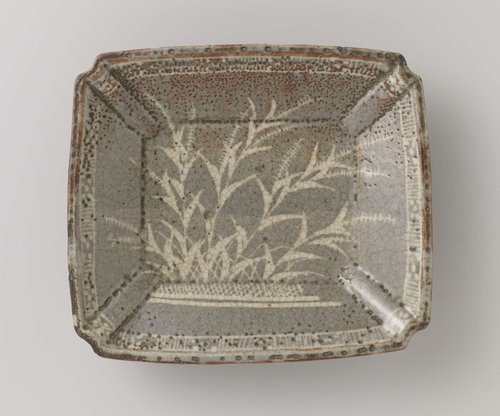
Rectangular dish with plants
c. 1600
Medium
stoneware
Dimensions
4.8; 19.8; 22.5; 13; 10.7
Rights
Public Domain
About this artwork
Rechthoekige schaal van steengoed met inspringende hoeken en staande op vier korte voeten, bedekt met een wit slib en een groen glazuur. Op het plat een ingegrifte decoratie van een groep planten (grashalmen?); de binnenrand met een band met strepen en stippen. De ingegrifte decoratie is gevuld met een wit slib (mishima-techniek). Twee oude labels op de onderzijde met 'Shino ware, so called Shino-Sotan. About 1600. Probably the work of captured Korean potters/ V. Transactions Ja[panese] Society,...
Art Historical Context
This rectangular stoneware dish, created around 1600, exemplifies the refined aesthetic of early Japanese Shino ware from the Mino region. Standing on four short feet with indented corners, it features an incised design of grasses or plants on its surface, executed in the mishima technique—where white slip is inlaid into carved lines for subtle contrast beneath a green glaze. A decorative band of stripes and dots along the inner rim adds rhythmic detail, reflecting the period’s appreciation for natural motifs and understated elegance. Shino ware emerged during Japan’s Momoyama era, a time when Korean potters, captured during military campaigns, brought advanced ceramic knowledge that blended with local traditions. Often linked to tea ceremony culture, such dishes were prized for their tactile qualities and organic forms. Labels on this piece associate it with the legendary Shino-Sotan style, highlighting its possible connection to influential 16th-century workshops and the cross-cultural exchanges that shaped Japanese ceramics. The combination of stoneware durability and delicate slip decoration makes this work a compelling example of technical innovation and artistic restraint, inviting viewers to appreciate both its functional beauty and historical resonance.
About the Artist
anonymous
In the vast tapestry of art history, "Anonymous" stands not as a singular individual but as a collective designation for countless unidentified creators whose works have endured across millennia. These artists, spanning prehistoric cave painters to medieval illuminators and folk craftsmen, produced the foundational layers of human visual culture. Prior to the Renaissance, when individual fame emer...