
Rectangular Plaque
Unknown Artist
middle of the 6th century
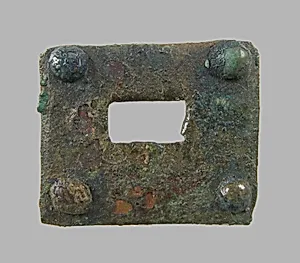
Medium
Copper alloy
Dimensions
Overall: 1 1/16 x 7/8 x 1/4 in. (2.7 x 2.3 x 0.7 cm)
Classification
Metalwork-Copper alloy
Culture
Frankish
Department
Medieval Art
Museum
Metropolitan Museum of Art, New York, NY
Credit
Gift of J. Pierpont Morgan, 1917
Accession Number
17.193.245
Rights
Public Domain
Art Historical Context
This delicate Rectangular Plaque, crafted in the mid-6th by an unknown Frankish artisan, exemplifies the refined metalworking traditions of early medieval Europe. Made from copper alloy—a durable and versatile material favored for its workability and corrosion resistance—the plaque measures just 1 1/16 x 7/8 x 1/4 inches, suggesting it was likely a component of personal adornment, such as jewelry or harness fittings. Its small scale highlights the precision of Frankish craftsmanship during the Merovingian period, when the Franks dominated much of Gaul (modern France and Germany) following the fall of Rome. Historically, this artifact bridges late antiquity and the Middle Ages, reflecting a fusion of Roman techniques with emerging Germanic styles. Frankish metalworkers excelled in casting and possibly chasing or engraving copper alloys, producing objects that conveyed status and cultural identity amid a shifting post-Roman world. Such plaques often featured intricate designs symbolizing power or protection, underscoring the Franks' role in shaping medieval art. A generous gift to the Metropolitan Museum of Art from J. Pierpont Morgan in 1917, this piece invites us to marvel at the artistry of everyday elites over 1,400 years ago, preserved in the Medieval Art collection.