
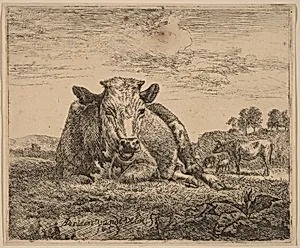
Recumbent Cow
Medium
etching
Classification
Department
CG-E
Museum
National Gallery of Art, Washington, D.C.
Credit
Rosenwald Collection
Accession Number
1943.3.8224
Rights
Public Domain
Art Historical Context
In the tranquil etching *Recumbent Cow* (1657), Dutch Golden Age artist Adriaen van de Velde captures the gentle repose of a resting bovine with remarkable sensitivity. At just 21 years old van de Velde—a master of landscape and animal painting—demonstrates his precocious talent in this intimate study. Housed in the National Gallery of Art'swald Collection (Department CG-E), this print exemplifies the 17th-century Dutch fascination with nature's quiet beauty amid the era's economic prosperity and scientific curiosity about the natural world. Van de Velde's style blends realism with poetic lyricism, influenced by the Baroque emphasis on light, texture, and atmosphere. His etchings, like this one, showcase meticulous line work: fine, fluid strokes render the cow's soft fur, curved form, and relaxed posture, evoking a sense of pastoral peace. Etching, a revolutionary intaglio technique using acid to incise copper plates, allowed artists like van de Velde to produce detailed, reproducible images that democratized fine art beyond oil paintings. This modest yet masterful work highlights van de Velde's legacy—he died young at 35 but left an indelible mark on animalier art. Visitors to our virtual gallery can marvel at how such a simple subject conveys profound harmony between humanity and the animal kingdom.
About the Artist
Adriaen van de Velde · 1636–1672
Adriaen van de Velde (1636–1672) was a Dutch Golden Age painter, draftsman, and etcher renowned for his luminous pastoral landscapes and his extraordinary versatility. Born in Amsterdam, he was the son of the marine painter Willem van de Velde the Elder and brother of the marine painter Willem van de Velde the Younger. He studied under Jan Wijnants, a landscape specialist, and possibly under Phili...