
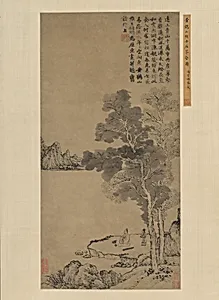
元 王蒙 丹崖翠壑圖 軸|Red Cliffs and Green Valleys
ca. 1367
Medium
Hanging scroll; ink on paper
Dimensions
Image: 26 3/4 x 13 1/2 in. (67.9 x 34.3 cm) Overall with mounting: 91 1/4 x 21 3/8 in. (231.8 x 54.3 cm) Overall with knobs: 91 1/4 x 25 1/8 in. (231.8 x 63.8 cm)
Classification
Paintings
Culture & Period
China · Yuan dynasty (1271–1368)
Department
Asian Art
Museum
Metropolitan Museum of Art, New York, NY
Credit
Ex coll.: C. C. Wang Family, Purchase, Gift of Darius Ogden Mills and Gift of Mrs. Robert Young, by exchange, 1973
Accession Number
1973.121.7
Rights
Public Domain
Tags
Art Historical Context
Wang Meng's *Red Cliffs and Green Valleys*丹崖翠壑圖), created around 1367 during the waning years of China's Yuan dynasty (12711368), is a hanging scroll in ink on paper. This intimate format, measuring about 27 x 13 inches in its image area, was designed private contemplation, unrolled in scholarly studios to evoke the sublime harmony of nature. Towering crimson cliffs rise dramatically against lush emerald valleys, dotted with ancient trees and subtle human figures—likely wandering scholars—lost in the vast wilderness. As one of the Four Great Masters of the Yuan, Wang Meng embodied the literati painting tradition, born from scholar-officials' retreat from Mongol rule. Rejecting ornate imperial styles, he pioneered dense, multi-layered compositions with intricate brushwork and subtle ink washes, building misty depths that suggest infinite space and spiritual introspection. His works often symbolize reclusion and Daoist ideals, turning rugged landscapes into meditative realms. Acquired by the Metropolitan Museum of Art in 1973 from the esteemed C. C. Wang collection, this scroll exemplifies Yuan art's profound cultural legacy: a bridge between Song dynamism and Ming refinement, inviting viewers to ponder nature's enduring poetry amid historical flux.
About the Artist
Wang Meng · 1308–1385
Chinese, ca. 1308–1385