
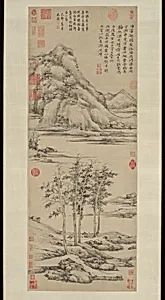
元 倪瓚 虞山林壑圖 軸|Woods and Valleys of Mount Yu
dated 1372
Medium
Hanging scroll; ink on paper
Dimensions
Image: 37 1/4 x 14 1/8 in. (94.6 x 35.9 cm) Overall with mounting: 82 x 20 5/8 in. (208.3 x 52.4 cm) Overall with knobs: 82 x 24 5/8 in. (208.3 x 62.5 cm)
Classification
Paintings
Culture & Period
China · Yuan dynasty (1271–1368)
Department
Asian Art
Museum
Metropolitan Museum of Art, New York, NY
Credit
Ex coll.: C. C. Wang Family, Gift of The Dillon Fund, 1973
Accession Number
1973.120.8
Rights
Public Domain
Tags
Art Historical Context
Ni Zan's *Woods and Valleys Mount Yu* (1372) is a masterful hanging scroll in ink on paper, exemplifying the refined aesthetic of Yuan dynasty literati painting. late in the artist's life—after the Yuan court's fall to the Ming—this vertical composition measures nearly 37 inches tall, designed for intimate contemplation when unrolled. Ni Zan (1301–1374), one of the "Four Masters of the Yuan captured the rugged beauty of Mount Yu (Yushan) in Jiangsu province, a site revered by scholars for its serene woods, misty valleys, and towering peaks. Renowned for his sparse, minimalist style, Ni employed economical brushstrokes and vast expanses of blank space to evoke spiritual detachment and purity amid political turmoil. Foreground trees stand stark and elegant, rendered with dry brush for textured bark, while distant mountains fade into subtle ink washes, creating a sense of infinite depth. This "literati" approach prioritized personal expression over photographic realism, reflecting the artist's reclusive ethos and disdain for officialdom. Housed in the Metropolitan Museum of Art's Asian Art department, this work highlights the cultural pinnacle of Chinese landscape painting, where nature symbolized moral integrity. Visitors, pause to absorb its quiet elegance—a timeless invitation to inner reflection.
About the Artist
Ni Zan · 1301–1374
Ni Zan (1301–1374), born into a wealthy scholarly family in Wuxi, Jiangsu province, exemplified the reclusive literati ideal during the turbulent Yuan dynasty. Receiving a rigorous Confucian education amid Mongol rule's restrictions on Han Chinese officials, he cultivated poetry, calligraphy, and painting as expressions of personal integrity rather than professional pursuits. No formal teachers or...