
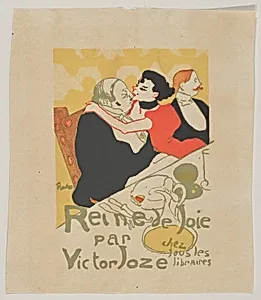
Reine de Joie
Medium
Color lithograph, reduced from poster
Dimensions
sheet: 6 1/4 x 5 1/2 in. (15.9 x 14 cm)
Classification
Prints
Department
Drawings and Prints
Museum
Metropolitan Museum of Art, New York, NY
Credit
Alfred Stieglitz Collection, 1949
Accession Number
49.55.164
Rights
Public Domain
Tags
Art Historical Context
Henri de Toulouse-Lautrec’s *Reine de Joie* (1892) is a vibrant color lithograph originally created as a poster and later reduced to its intimate sheet size of 6 1/4 by 5 1/2 inches. As a master of graphic art, Toulouse-Lautrec used the medium’s bold lines and layered colors to capture the lively social world of fin-de-siècle Paris. The work’s classification as a print and its inclusion in the Metropolitan Museum of Art’s Alfred Stieglitz Collection highlight its dual role as both commercial design and fine art. Toulouse-Lautrec’s style combined swift, expressive drawing with a keen eye for modern urban life. The tags noting men and women suggest the reflects the interactions and energy of Parisian nightlife, a recurring theme in his oeuvre. By adapting poster techniques to a smaller format, he helped elevate lithography from advertising tool to respected artistic medium during the Belle Époque. This reduced print demonstrates how Toulouse-Lautrec bridged high art and popular culture, making dynamic scenes of contemporary society available to a wider audience. Its presence in a major museum collection affirms its lasting significance in the history of printmaking.
About the Artist
Henri de Toulouse-Lautrec · 1864–1901
Henri Marie Raymond de Toulouse-Lautrec-Montfa (1864-1901) was a French Post-Impressionist painter, printmaker, and illustrator whose innovative poster designs revolutionized graphic art and advertising in late 19th-century Paris. Born into an aristocratic family at Albi in southern France, Toulouse-Lautrec's privileged lineage traced back to the Counts of Toulouse and extended uninterrupted to th...