
Rejected Geisha from Passions Cooled by Springtime Snow
1824
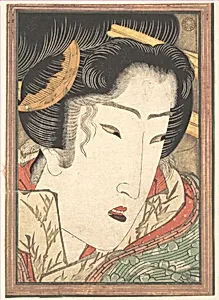
Medium
Woodblock print; ink and color on paper
Dimensions
H. 7 in. (17.8 cm); W. 5 in. (12.7 cm)
Classification
Prints
Culture & Period
Japan · Edo period (1615–1868)
Department
Asian Art
Museum
Metropolitan Museum of Art, New York, NY
Credit
Gift of Estate of Samuel Isham, 1915
Accession Number
JP1066
Rights
Public Domain
Tags
Art Historical Context
This woodblock print by Keisai Eisen, created in 1824 during Japan’s Edo period, captures a poignant moment in the life of a geisha. Titled *Rejected Geisha* from the series *Passions Cooled by Springtime Snow*, the small-format work (just 7 by 5 inches) depicts a woman’s expressive face, rendered with delicate lines and subtle color washes typical of ukiyo-e prints. Eisen, a leading figure in the late Edo ukiyo-e school, specialized in bijin-ga—images of beautiful women—often exploring themes of love, longing, and fleeting emotion drawn from urban pleasure quarters. In the bustling city of Edo, geishas and courtesans occupied a complex social world shaped by both glamour and constraint. Woodblock printing allowed such scenes to reach a wide audience through affordable, reproducible art that blended literature, theater, and daily life. The title’s poetic reference to cooled passions suggests a narrative of rejection or melancholy, inviting viewers to imagine the inner world behind the composed exterior. Today housed in the Metropolitan Museum of Art, this intimate print exemplifies how ukiyo-e artists transformed personal and social stories into enduring visual poetry, preserving the emotional textures of Edo-era Japan for modern audiences.
About the Artist
Keisai Eisen · 1790–1848
Keisai Eisen (1790–1848), born Ikeda Yoshinobu in Edo (modern Tokyo), emerged as one of the late Edo period's most prolific ukiyo-e masters. The son of the renowned calligrapher and Kanō-school painter Ikeda Shigeharu, Eisen was immersed in the arts from childhood. He apprenticed under Kanō Hakkeisai, adopting the art name "Keisai" in homage to his teacher, and later studied bijin-ga (images of be...