
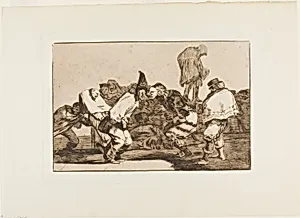
Rejoice, Carnival, for Tomorrow Thou wilt Be Ashes, plate 14 from Los Proverbios
Medium
Etching and aquatint printed in sepia ink on ivory wove paper
Dimensions
Image: 21.1 × 32.4 cm (8 5/16 × 12 13/16 in.); Plate: 24.5 × 35.8 cm (9 11/16 × 14 1/8 in.); Sheet: 35.1 × 48.7 cm (13 7/8 × 19 3/16 in.)
Classification
etching
Department
Prints and Drawings
Museum
Art Institute of Chicago
Accession Number
44879
Rights
Public Domain
About this artwork
This group of leering figures in masks refers to the Roman Catholic festival Carnival, which (then, as now) precedes the more contemplative season of Lent. Goya used the common proverb of the title to compare the festival’s unsustainable indulgence and ritual pomp with the fate of Catholicism itself. In his art Goya frequently criticized the hypocrisy of the Spanish national religion, specifically its clergy. Both his Proverbs series and the Disasters of War, several etchings of which are also o...
Art Historical Context
In Francisco Goya's *Rejoice, Carnival, Tomorrow Thou wilt Be Ashes*, plate 14 from series *Los Proverb* (also known as *Los Disparates created between 1815 and 1824, the artist captures a macabre carnival revelry echoing the Spanish proverb that warns of fleeting pleasures and inevitable death—a classic *memento mori*. This late print reflects Goya's shift toward surreal, nightmarish visions in his final years, amid Spain's turbulent post-Napoleonic recovery. As a master of Romanticism and precursor to modernism, Goya uses grotesque figures in chaotic motion to critique human folly and mortality. Printed in sepia ink on ivory wove paper via etching and aquatint, the work showcases Goya's innovative printmaking prowess. Etching provides precise lines for dynamic outlines, while aquatint adds rich, velvety tones mimicking painting's depth, allowing subtle gradations that heighten the eerie atmosphere. At 21.1 × 32.4 cm, its intimate scale invites close scrutiny of the swirling, masked crowd. Housed in the Art Institute of Chicago's Prints and Drawings Department, this piece from Goya's enigmatic, posthumously published series underscores his enduring cultural impact, blending satire with psychological insight to challenge viewers on life's transience.
About the Artist
Francisco José de Goya y Lucientes · 1746–1828
Francisco José de Goya y Lucientes was born on March 30, 1746, in the small Aragonese village of Fuendetodos, Spain, to José Benito de Goya, a master gilder, and Gracia de Lucientes. The fourth of six children in a modest lower-middle-class family, Goya received a basic education before beginning his artistic training at age 14 under the local painter José Luzán y Martínez in Zaragoza, where he sp...