
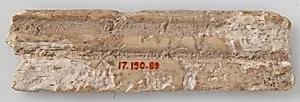
Relief Fragment
Unknown Artist
6th–7th century
Medium
Ivory
Dimensions
Overall: 9/16 x 1/16 x 2 1/16 in. (1.4 x 0.2 x 5.3 cm) with 17.190.84-5, .89: 9/16 x 7 13/16 x 1/16 in. (1.4 x 19.9 x 0.2 cm)
Classification
Ivories
Culture
Coptic
Department
Medieval Art
Museum
Metropolitan Museum of Art, New York, NY
Credit
Gift of J. Pierpont Morgan, 1917
Accession Number
17.190.89
Rights
Public Domain
Art Historical Context
This delicate **Relief Fragment**, carved from ivory in 6th–7th century Cop Egypt, offers a glimpse into the vibrant of early Christian art. to the Medieval Art department at the Metropolitan Museum of Artthanks to a 1917 gift from J. Pier Morgan—this tiny piece (just 9/16 x 1/16 x 2 1/16 inches) is part of a larger reconstructed object, highlighting the precision of ancient craftsmanship. Ivory, a luxurious and portable medium prized in the Byzantine-influenced Coptic world, allowed artisans to create intricate reliefs for religious items like book covers, caskets, or liturgical objects. Coptic carvers blended Egyptian motifs with Christian symbolism, often depicting biblical scenes or saints in shallow, expressive reliefs that captured light and shadow beautifully despite the material's fragility. From Egypt's monastic centers, where Christianity flourished amid Roman and Islamic transitions, such fragments reveal a fusion of cultures. Though worn by time, this artwork underscores the spiritual devotion and technical mastery of Coptic workshops, inviting us to ponder the hands that shaped it over 1,400 years ago.