
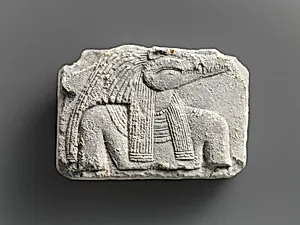
Relief plaque, upper part of crocodile-headed god
Unknown Artist
400–30 B.C.
Medium
Limestone
Dimensions
H. 6 cm (2 3/8 in.); W. 8.7 cm (3 7/16 in.); D. 2.5 cm (1 in.)
Classification
Sculptor's model/votive, upper part of crocodile-headed god
Period
Late Period–Ptolemaic Period
Department
Egyptian Art
Museum
Metropolitan Museum of Art, New York, NY
Credit
Gift of Lily S. Place, 1921
Accession Number
21.6.25
Rights
Public Domain
Art Historical Context
This delicate limestone relief plaque, depicting the upper part of a crocodile-headed god, dates to Egypt's Late Period through the Ptolemaic era (400–30 B.C.). Carved in low relief, the small artifact—measuring just 6 cm high—likely once formed part of a larger votive object, amulet, or temple decoration. Its compact size suggests it was portable, perhaps used in personal devotion or ritual contexts. The crocodile-headed deity is almost certainly Sobek, a Egyptian god embodying the Nile's fertile yet dangerous waters. Worshipped especially in the Fayum region, Sobek symbolized protection, fertility, and pharaonic might, often merging with creator gods like Ra. During the Ptolemaic Period, under Greek rulers who blended Hellenistic and native traditions, such reliefs bridged old Egyptian piety with new dynastic influences, highlighting cultural continuity amid political change. Crafted from durable limestone—a staple medium for Egyptian sculpture—this piece exemplifies the era's precise carving techniques, where fine details emerge through subtle incisions and polishing. Donated to the Metropolitan Museum of Art in 1921 by Lily S. Place, it offers visitors a tangible glimpse into ancient Egypt's vibrant religious world.