
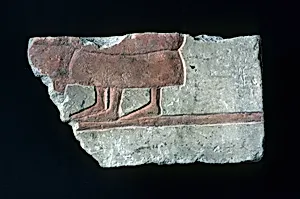
Relief with two foreigners
Unknown Artist
ca. 1353–1336 B.C.
Medium
Limestone, paint (mostly modern)
Dimensions
h. 22.8 cm (9 in); w. 40 cm (15 3/4 in)
Classification
Talatat, foreigners
Period
New Kingdom, Amarna Period
Department
Egyptian Art
Museum
Metropolitan Museum of Art, New York, NY
Credit
Gift of Mr. and Mrs. Jonathan P. Rosen, 1991
Accession Number
1991.237.75
Rights
Public Domain
Tags
Art Historical Context
This exquisite limestone relief, titled *Relief with Two Foreigners*, hails from Egypt's New Kingdom during the Amarna Period (ca. 1353–1336 B.C.), a transformative era under Pharaoh Akhenaten's rule in Dynasty 18. Crafted by an unknown artist, it exemplifies the revolutionary Amarna style, which broke from rigid conventions with more naturalistic proportions, fluid lines, and a sense of movement—reflecting the pharaoh's radical religious reforms centered on the sun god Aten. Measuring 22.8 cm high and 40 cm wide, the low-relief carving once bore vibrant paints, though most visible color today is modern restoration. The focus on two foreigners—likely non-Egyptians such as Libyans or Nubians, inferred from the title—highlights ancient Egypt's worldview of cultural dominance and tribute. Details like the tagged emphasis on feet suggest dynamic striding poses, capturing ethnicity through distinct hairstyles, attire, or features, a common motif symbolizing subjugation or exoticism. Housed in the Metropolitan Museum of Art's Egyptian Art Department as a 1991 gift from Mr. and Mrs. Jonathan P. Rosen, this piece offers a window into Amarna's artistic boldness and imperial narrative, reminding us how ancient Egyptians portrayed the world beyond their borders.