
Reliquary
Unknown Artist
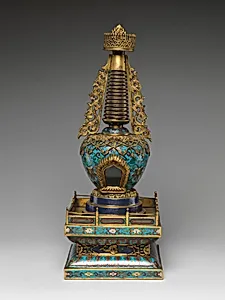
Medium
Cloisonné enamel and bronze
Dimensions
H. 19 in. (48.3 cm)
Classification
Cloisonné
Culture & Period
China · Qing dynasty (1644–1911), Qianlong period (1736–95)
Department
Asian Art
Museum
Metropolitan Museum of Art, New York, NY
Credit
Bequest of Edward G. Kennedy, 1932
Accession Number
33.40.68
Rights
Public Domain
Tags
Art Historical Context
This elegant reliquary, crafted in cloisonné enamel and bronze China's Qing dynasty Qianlong period (1736–95), stands as a testament to the era's imperial artistry. Measuring 19 inches (48.3 cm) in height, it hails from the opulent workshops patronized by the Qianlong, a fervent collector and innovator in decorative arts. Now housed in the Metropolitan Museum of Art's Asian Art—thanks to the 1932 bequest of G. Kennedy—this piece exemplifies cloisonné, a technique where thin metal wires (cloisons) are soldered onto a bronze base to form intricate cells. These compartments are filled with vibrant glass enamels in shades of turquoise, red, and gold, then fired repeatedly and polished to a luminous sheen. Cloisonné enamel reached its zenith in the Qing dynasty, blending European influences from Jesuit missionaries with Chinese ingenuity. Prized for its jewel-like durability and vivid colors, it adorned palace treasures, ritual vessels, and religious objects like this reliquary, designed to safeguard sacred relics. In Qianlong's court, such works symbolized imperial prestige and spiritual devotion, often produced in the imperial kilns of Beijing's Zaobanchu bureau. Though the artist's identity remains unknown, the reliquary's meticulous craftsmanship invites visitors to marvel at Qing China's fusion of technology, piety, and aesthetics—a bridge between the earthly and divine.