
Reliquary Diptych
Unknown Artist
late 14th century
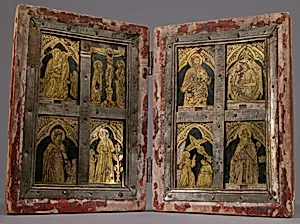
Medium
Verre églomisé, polychromy, wood, and metal
Dimensions
Overall (open): 8 3/8 x 12 1/2 x 9/16 in. (21.3 x 31.7 x 1.4 cm) Overall (closed): 8 3/8 x 6 1/8 x 1 1/8 in. (21.3 x 15.6 x 2.9 cm) each image (approx.): 2 13/16 x 1 5/8 in. (7.2 x 4.2 cm)
Classification
Glass-Verre églomisé
Culture
Central Italian
Department
Medieval Art
Museum
Metropolitan Museum of Art, New York, NY
Credit
Gift of J. Pierpont Morgan, 1917
Accession Number
17.190.922
Rights
Public Domain
Tags
Art Historical Context
Step into the devotional world of the *Reliquary Dipt*, a gem from late 14th Central Italy now housed in the Metropolitan Museum Art's Medieval Art department. This intimate, folding artwork—measuring just 8 3/8 x 12 1/2 inches when open—served as a personal reliquary, safeguarding holy relics within its wooden panels framed in metal. Adorned with luminous scenes of the Madonna and Child, Crucifixion, and saints, it captures the era's fervent piety amid Italy's Gothic artistic flowering, where faith and artistry intertwined for elite devotees. The diptych's standout medium, *verre églomisé*, reveals masterful technique: thin glass panels backed with gold leaf, delicately painted, and enhanced by vibrant polychromy on wood. This labor-intensive process created a glowing, jewel-like effect, evoking heavenly radiance while protecting fragile images (each roughly 2 13/16 x 1 5/8 inches). Such portable treasures were prized by pilgrims and nobility, blending Byzantine influences with local Italian innovation. A generous gift from J. Pierpont Morgan in 1917, this anonymous work endures as a testament to medieval craftsmanship—compact yet profound, inviting quiet contemplation of Christ's life and sainthood in everyday devotion.