
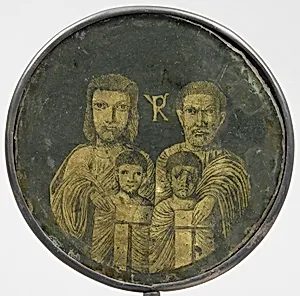
Medallion with Family Portrait
Unknown Artist
18th century (4th century style)
Medium
Verre églomisé
Dimensions
Overall (w/out mount): 1/8 x 3 1/4 in. (0.3 x 8.2 cm) Overall (w/ mount): 5 1/4 x 3 1/4 x 1 7/8 in. (13.3 x 8.2 x 4.8 cm)
Classification
Glass-Verre églomisé
Culture
Italian
Department
Medieval Art
Museum
Metropolitan Museum of Art, New York, NY
Credit
Gift of J. Pierpont Morgan, 1917
Accession Number
17.190.108
Rights
Public Domain
Tags
Art Historical Context
This exquisite medallion, crafted in the 18th century yet styled after 4th-century early Christian art, showcases the enduring appeal of verre églomisé, a delicate glass technique involving gold leaf application and intricate engraving. Created by an unknown Italian artist, the piece captures a family portrait within a circular frame, evoking the intimate commemorative medallions of late antiquity. Its small scale—just over three inches wide—highlights the precision required to etch fine details onto the gilded surface, a method that flourished in Europe as a luxurious decorative art form. Housed in the Metropolitan Museum of Art’s Department of Medieval Art, the medallion reflects 18th-century fascination with classical revival, blending Renaissance-era craftsmanship with ancient motifs. Verre églomisé allowed artists to achieve luminous, jewel-like effects that mimicked precious metals and stones, making such objects treasured for both personal devotion and display. Gifted by J. Pierpont Morgan in 1917, it stands as a testament to Italy’s rich tradition of glasswork and the timeless human desire to preserve family legacies through art.