
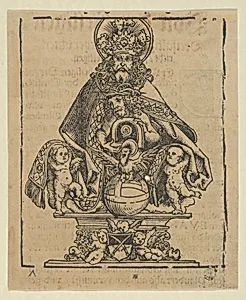
Reliquary with the Trinity
Medium
Woodcut
Dimensions
Sheet: 5 3/8 × 4 1/8 in. (13.6 × 10.5 cm)
Classification
Prints
Department
Drawings and Prints
Museum
Metropolitan Museum of Art, New York, NY
Credit
Harris Brisbane Dick Fund, 1927
Accession Number
27.54.75
Rights
Public Domain
Tags
Art Historical Context
Lucas Cranach the Elder, leading figure of the German Renaissance, masterfully captured spiritual devotion in *Reliquary with the*, a compact woodcut print from his prolific workshop. Known for vivid Northern Renaissance style—blending intricate detail with expressive figures—Cranach produced numerous woodcuts that democratized religious art during the early 16th century. This petite sheet, measuring just 5 3/8 × 4 1/8 inches, exemplifies the medium's power: woodcuts allowed for affordable, reproducible images, spreading iconography far beyond elite patrons. The composition centers on a reliquary, a ornate container for holy relics, enshrining the Holy Trinity with Christ prominently featured alongside playful putti—those cherubic child angels symbolizing divine joy and innocence. These elements evoke the era's intense piety, where such images served as aids for prayer and contemplation amid the Protestant Reformation, in which Cranach himself played a role as a supporter of Martin Luther. Housed in the Metropolitan Museum of Art's Drawings and Prints department (Harris Brisbane Dick Fund, 1927), this work highlights woodcut's technical brilliance: carved into wood blocks, inked, and pressed onto paper, it reveals Cranach's skill in achieving fine lines and textures on a small scale. A testament to Renaissance innovation, it invites visitors to ponder faith's tangible forms.
About the Artist
Lucas Cranach the Elder · 1472–1553
Lucas Cranach the Elder (c. 1472-1553) was one of the most prominent German Renaissance painters and a key artistic figure of the Protestant Reformation. Born in Kronach, Franconia, to the painter Hans Maler, Cranach began his career in Vienna around 1502, where he became one of the founders of the Danube School, a movement characterized by expressive landscape painting and emotional force. His ea...