
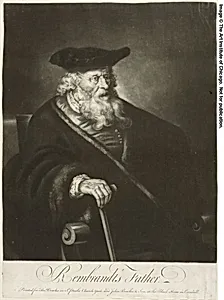
Rembrandt's Father
n.d.
Medium
Mezzotint in black on paper
Dimensions
Image: 31.3 × 25.8 cm (12 3/8 × 10 3/16 in.); Sheet, cut within platemark: 35.6 × 25.7 cm (14 1/16 × 10 1/8 in.)
Classification
mezzotint
Department
Prints and Drawings
Museum
Art Institute of Chicago
Accession Number
46431
Rights
Public Domain
Art Historical Context
James McArdell’s “Rembrandt’s Father” is a striking mezzotint that pays homage to the Dutch master through the lens of eighteenth-century British printmaking. Created in rich black ink on paper, the work captures the dignified features of Harman Gerritszoon van Rijn, Rembrandt’s father, whose likeness had already become iconic through the artist’s own paintings and etchings. McArdell, an Irish engraver celebrated for his reproductive prints after Old Masters, translated this intimate subject into a tonal medium prized for its velvety depths and subtle gradations of light. Mezzotint’s distinctive technique—roughening the plate to hold ink and then smoothing areas to create highlights—allowed McArdell to evoke the luminous quality of Rembrandt’s original portraits while making them accessible to a wider audience. Such prints played a vital role in spreading appreciation for seventeenth-century Dutch art across Europe during the 1700s, when original paintings remained largely in private collections. Housed in the Art Institute of Chicago’s Department of Prints and Drawings, this impression preserves both Rembrandt’s personal subject matter and McArdell’s masterful command of tone, offering visitors a window into how artistic legacies were shared and reinterpreted through the reproductive print.
About the Artist
James McArdell · 1729–1765
**James MacArdell** (c. 1729 – 2 June 1765) was an Irish mezzotint engraver renowned for his masterful portraits of prominent figures in 18th-century Britain and Ireland. Born in Cow Lane (later Greek Street) in Dublin’s St Michan’s Parish, he trained under the engraver John Brooks. When Brooks relocated to London in 1746, MacArdell followed along with fellow pupils including Charles Spooner, esta...