
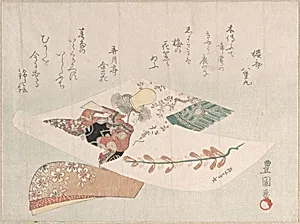
Representation of the Dance-Play "Dōjōji"
Medium
Woodblock print (surimono); ink and color on paper
Dimensions
5 1/2 x 7 3/8 in. (14 x 18.7 cm)
Classification
Prints
Culture & Period
Japan · Edo period (1615–1868)
Department
Asian Art
Museum
Metropolitan Museum of Art, New York, NY
Credit
H. O. Havemeyer Collection, Bequest of Mrs. H. O. Havemeyer, 1929
Accession Number
JP2211
Rights
Public Domain
Tags
Art Historical Context
Step into the vibrant world of Edo-period Japan with Utagawa Toyokuni's *Representation of the-Play "Dōjōji"*, a surimono woodblock print from the early 19th century. Toyokuni I, a master of the uki-e tradition and leading figure in the Utagawa school, specialized in capturing the glamour of kabuki theater and beautiful women. This intimate print5 1/2 x 7 3/8 in.) depicts elegant female performers from the famed *Dōjōji* dance-play, adorned with flowing robes and floral motifs that evoke grace and drama. Surimono, meaning "printed things," were luxurious, privately commissioned prints often produced for New Year's greetings or poetry gatherings, featuring richer colors, embossing, and subtle mica highlights compared to commercial ukiyo-e. Here, Toyokuni's precise ink and color on paper bring to life the serpentine allure of *Dōjōji*—a kabuki adaptation of a Noh tale about a jealous woman's vengeful spirit pursuing her lover beneath a temple bell. The floral elements symbolize fleeting beauty, mirroring ukiyo-e's theme of *mono no aware* (the pathos of things). Housed in the Metropolitan Museum of Art's Asian Art collection (H. O. Havemeyer Collection, 1929), this work highlights Japan's theatrical culture during the Edo period (1615–1868), when kabuki flourished amid urban prosperity. Toyokuni's dynamic compositions immortalized stars like Onoe Kikugorō, making theater accessible to all—a testament to woodblock printing's democratic artistry.
About the Artist
Utagawa Toyokuni I · 1777–1835
Japanese, 1777–1835