
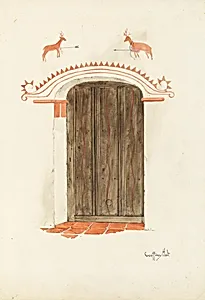
Restoration Drawing: Wall Decoration Over Doorway, Facade of Mission-House
c. 1937
Medium
watercolor, colored pencil, and graphite on paper
Dimensions
overall: 35.7 x 24.5 cm (14 1/16 x 9 5/8 in.) Original IAD Object: Door approx: 6'3" x 3'3"
Classification
Index of American Design
Department
CG-W
Museum
National Gallery of Art, Washington, D.C.
Credit
Index of American Design
Accession Number
1943.8.5941
Rights
Public Domain
Art Historical Context
In the heart of the Index of American Design, a landmark WPA project from the Great Depression era, Geoffrey Holt's *Restoration Drawing: Wall Over Doorway, Fac of Mission-House*c. 1937) captures the intricate charm of early American architecture. Created with watercolor, colored pencil, graphite on paper (35.7 x 24.5 cm), this rendering documents the decorative details above a doorway measuring approximately 6'3" x 3'3" on a Mission-style house facade. These homes, inspired by Spanish colonial missions in the American Southwest, blended functionality with ornate motifs like carved shells, scrolls, and floral patterns, reflecting regional craftsmanship. Holt's work exemplifies the Index's mission: to preserve vanishing folk art and design through over 15,000 artist-renderings, ensuring cultural heritage endured economic hardship. The mixed-media technique allowed for vibrant, accurate color reproduction—watercolor for depth, colored pencil for precision, and graphite for fine lines—making it ideal for restoration efforts. Housed in the National Gallery of Art's collection, this drawing not only revives Mission-era aesthetics but invites us to appreciate how everyday architecture embodied America's diverse artistic spirit. Today, it reminds visitors of the WPA's creative legacy, transforming documentation into a celebration of national identity.
About the Artist
Geoffrey Holt · 1855–present
Geoffrey Holt was born in England on August 18, 1882, and received his artistic training in London and Paris before eventually making his career in the United States. After arriving in America, he lived in Minneapolis, where he worked as an interior designer for the John S. Bradstreet Company—an experience that developed his sensitivity to space, surface, and decorative harmony. By around 1920 he ...