
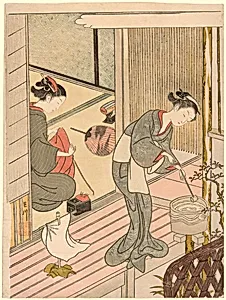
Returning Sails of the Towel Rack (Tenugui-kake no kihan), from the series "Eight Views of the Parlor (Zashiki hakkei)"
c. 1766
Medium
Color woodblock print; chuban, surimono
Dimensions
28.7 × 21.4 cm (11 1/4 × 8 1/2 in.)
Classification
woodblock print
Department
Arts of Asia
Museum
Art Institute of Chicago
Accession Number
88973
Rights
Public Domain
Art Historical Context
Suzuki Harunobu's *Returning Sails of theel Rack (Tenugui-kake no kihan)*, from the series * Views of the Parlor (Zashiki hakkei)*, captures a whimsical moment in everyday Japanese life around 1766. Part of a clever parody of the classic Chinese "Eight Views of Xiao-X" landscapes, this ukiyo-e woodblock print reimagines grand natural scenes as intimate domestic vignettes. Here, wet towels draped over a rack mimic the silhouettes of sails returning at dusk, evoking a poetic glow in a cozy parlor setting. Harunobu, a master of the Edo-period "floating world" genre, pioneered full-color *niishiki-e* prints, layering vibrant hues through intricate woodblock carving. This *chuban*-sized *surimono*—a luxurious, privately commissioned format often featuring embossed textures and poems—highlights his innovative techniques, blending humor with refined beauty. At 28.7 × 21.4 cm, its compact scale made it ideal for personal collections. Housed in the Art Institute of Chicago's Arts of Asia department, this print exemplifies Harunobu's influence on ukiyo-e, transforming mundane objects into evocative art and bridging traditional poetry with urban wit during Japan's vibrant 18th-century print culture.
About the Artist
Suzuki Harunobu · 1725–1770
Suzuki Harunobu (c. 1725-1770) was a Japanese ukiyo-e artist who revolutionized woodblock printing by developing nishiki-e—full-color prints using multiple woodblocks—in 1765. Before Harunobu, Japanese prints were limited to two or three colors; his innovation unleashed the entire artist's palette, transforming ukiyo-e into the vibrant art form that would later captivate Western artists from Manet...