
Revelry
1899
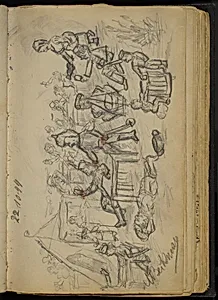
Medium
graphite with touches of crayon on wove paper
Classification
Drawing
Department
CG-W
Museum
National Gallery of Art, Washington, D.C.
Credit
Gift of Mrs. Max Beckmann
Accession Number
1984.64.64.41
Rights
Public Domain
Art Historical Context
**Revelry** (1899) is an early drawing by Max Beckmann, renowned German artist who later became a towering figure in Expressionism. Created when Beckmann was just beginning his artistic journey, this work on wove paper uses graphite with subtle touches of crayon, showcasing his budding mastery of line and subtle color. Wove paper, with its smooth, even texture, was a favored support for detailed drawings in the late 19th century, for precise shading and fluid marks that capture movement and energy. The title *Revelry* evokes scenes of joyous abandon—perhaps dancers or revelers in motion—reflecting the vibrant cultural spirit of fin-de-siècle Europe. Though predating Beckmann's mature, symbolic style marked by distorted forms and psychological depth, this piece hints at his lifelong fascination with human drama and carnival-like exuberance. As a graphite drawing, it highlights the intimacy of sketchwork, where spontaneity meets technical skill, offering a glimpse into the artist's formative years. Generously gifted to the National Gallery of Art by Mrs. Max Beckmann, *Revelry* resides in the museum's Department CG-W, classified simply yet evocatively as a drawing. It invites visitors to appreciate how even early experiments can foreshadow a brilliant career, bridging personal expression with broader artistic traditions.
About the Artist
Max Beckmann · 1884–1950
Max Carl Friedrich Beckmann (1884-1950) stands as one of the most significant German painters of the twentieth century, a complex artist who bridged Expressionism and the New Objectivity while forging a deeply personal visual language. Born in Leipzig into a middle-class family, Beckmann's artistic journey spanned from academic classicism through the traumatic crucible of World War I to a mature s...